

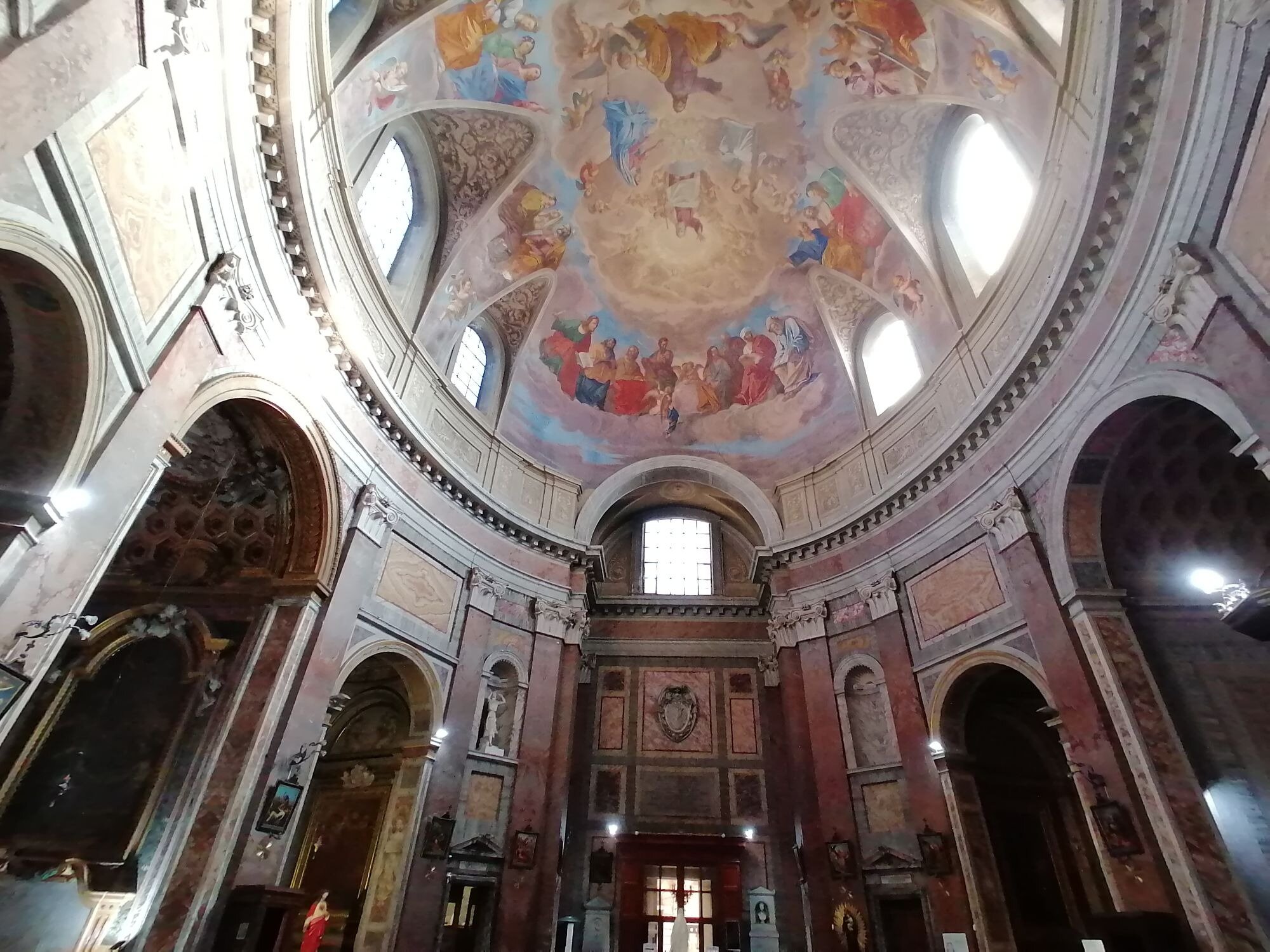
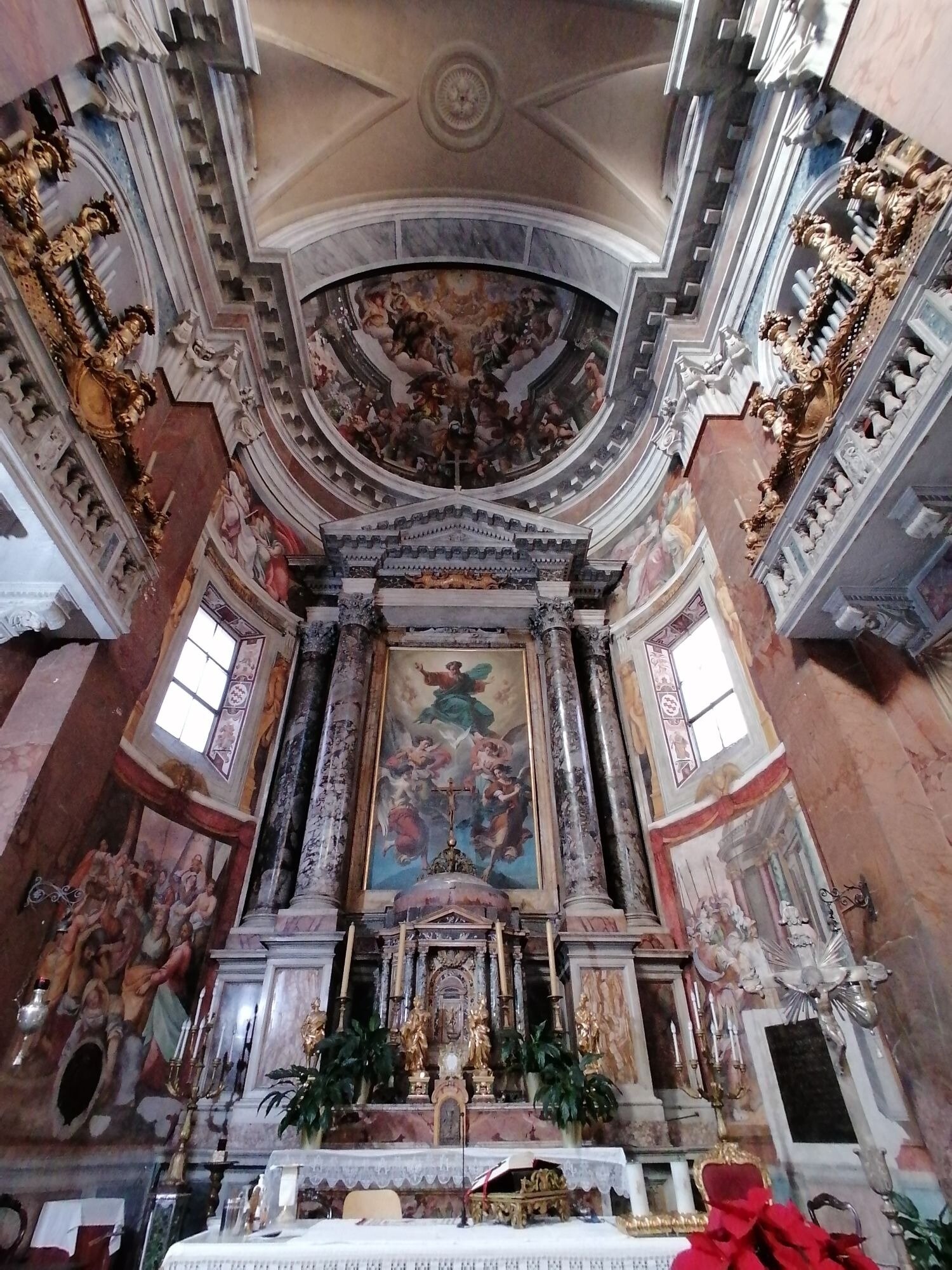
Via del Corso in Rome is not just the main shopping street because along this long avenue there are numerous churches and basilicas which can be defined as works of art! Among them, in the photo we have the Basilica of San Giacomo in Augusta, the first that you will find on the right along Via del Corso towards Piazza Venezia. Let's discover it.
It is a fairly recent church, for Roman history, considering that the first place of worship was founded in 1347, whose most great peculiarity lies in the fact that for centuries the church has always been linked to the concept of charity, to the care and assistance of the sick. In fact the first nucleus of the church was born from a small chapel inside the old San Giacomo degli Incurabili Hospital, where sick people, with no hope of survival, were housed awaiting the last of their days. A building whose main function, therefore, was to give spiritual assistance, rather than physical, to all those who no longer had any hope. Today the Basilica of San Giacomo in Augusta, as evidenced by the toponym, is in relation to Augustus (first emperor of Rome who left several architectonical witnesses, like his Forum), or rather to one of his architectural and urban projects: his fantastic mausoleum. Right here, near the church, in fact, the monumental remains of the extraordinary burial commissioned by Augustus, and also used by other emperors after him, are still visible today.
Then the church was embellished and renovated in the 17th century by architects and artists such as Salviati and Maderno, and of this period of considerable interest is the Chapel of the Miracle in which, on a white 17th-century high-relief, it was positioned a miraculous image of the Madonna. Note the baroque forms of the decorations and, above all, the fresco on the vault, which represents the "Glory of San Giacomo". In a post-Counter-Reformation period it was easy to see such representations, in which holy men or men in the odor of sanctity were used as warnings and examples for the faithful, to educate them in the faith. The example of St Giacomo (James), pictorially placed in glory in a profusion of angels and clouds and surrounded by light, reminded the faithful how much a just faith was always rewarded by God, and how much reference should always be made to men like saints, more capable than others of doing the will of God. It is not a case if a coeval fresco, that is host in the wonderful Basilica of Sant'Ignazio da Loyola, always in Rome, is able to show us the same message (and if you want to know more click here). The fact that the painted figures move free from any constraint, without any architectural, albeit pictorial, element that frames them, once again denounces how art in Rome was changing from the Renaissance age. Finally, the plan of the church is also striking, which has an elliptical shape surrounded by chapels a little unusual in the Roman panorama, but at the same time common in a period, the Baroque, which among its prerogatives had a certain eclecticism and a rejection of classic rules and canons typical of the Renaissance.