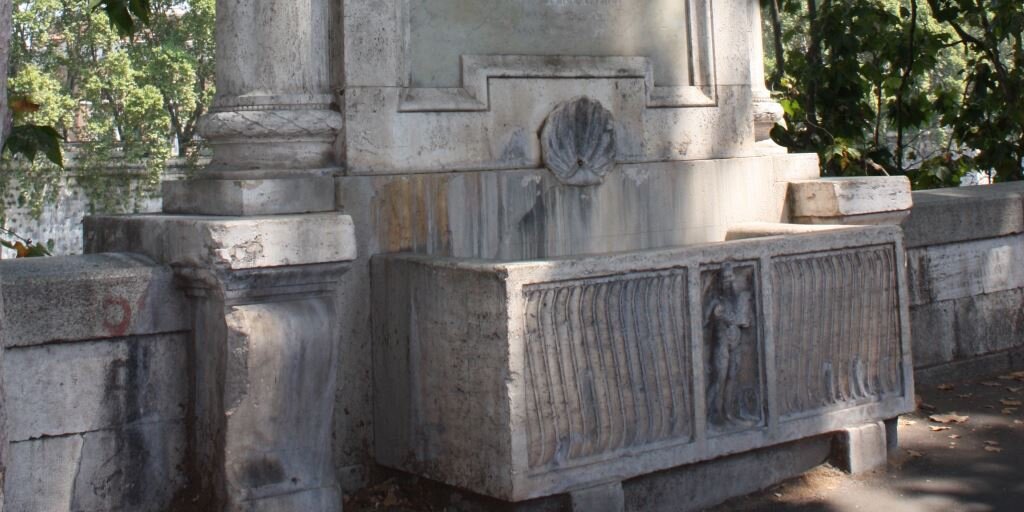
The Tor di Nona stele fountain, on the Lungotevere, is both a monument and a tribute by the city of Rome to opera as a whole…
By now you know, thanks to your local tour guide in Rome, that the Eternal City is home to monumental fountains, but also to something more hidden, concealed and noteworthy at the same time. I’m thinking of the Fontana dell'Acqua Acetosa, for example. But, strolling along the Lungotevere Tor di Nona, just a few steps from Piazza Navona, you will find an even more unusual fountain, since it is, at the same time, a small monument and a tribute to opera music. I’m talking about the so-called stele fountain of the Teatro Apollo. The lovely monumental ensemble was erected by the City of Rome in 1925 where, long before, there was a small landing along the Tiber river, complete with a watchtower of the ancient Aurelian Walls. Today, and already at the time, everything had been lost, of course, but to preserve the close bond between the modern city and the Urbe of the emperors, the fountain consists of a typically Roman sarcophagus topped by a new stele, with an attached epigraph. The classic meeting of past and present that in Rome never goes out of fashion. So let’s find out a bit more about the fountain, especially about the above-mentioned Teatro Apollo.

The temple of culture mentioned, the Apollo Theatre, was nothing other than the building in which opera, here in Rome, found its home. Founded in 1667, it was sadly demolished in 1888. Reason? The Embankment Walls of the Tiber. The grand engineering work that today, with its high travertine walls, protects the city of Rome from floods and inundations. It was after the disastrous flood of 1870 (as you can read here), that people really began to talk about how to safeguard the Eternal City from its river. And the Embankment Walls were the perfect solution. Too bad that, to do so, no expense was spared and they didn’t go in for half measures. Many buildings were moved or completely razed to the ground, as in the case of the Villa della Farnesina. And the Apollo Theatre was no exception, unfortunately. Just think that the first theatre came to life in a building originally obtained from a building belonging to a confraternity. The great architect Carlo Fontana was also involved in its construction. The theatre, also known as Tordinona, enjoyed a new, renewed splendour under the papacy of Clement XII in the first half of the 18th century, and then lived its golden moment at the beginning of the 19th century.
Just think that the building passed to the famous Prince Torlonia, to whom we also owe the Casino Nobile once owned by the celebrated Roman family. The architect Giuseppe Valadier was also involved to modernize and enlarge the building. Among the many things the fortunate spectators could attend, we count works by Rossini played by none other than Paganini, as well as works by Verdi or Doninzetti. Too bad that, following the 1873 master plan, 15 years later the entire building was demolished, as said before. Today, to recall how music and culture were the great protagonists of the vanished theatre, there is the stele that tops the traditional strigilated Roman sarcophagus. The epigraph was written by Fausto Salvatori, a poet and also a librettist who lived between the 19th and the 20th centuries. With the rhetoric and pomp typical of the time, the words left to imperishable memory that can still be read today on the stele (even if with some difficulty), leave us a reminder of a glorious past. Among the passages I quote “… libera si diffuse la pvra melodia d'Italia” or “… il genio di Givseppe Verdi affida l'eterna melodia canora all0aria al suore al cvuore vmano”. A praise of opera, of music, of the song. A praise to Italy, here in Rome.