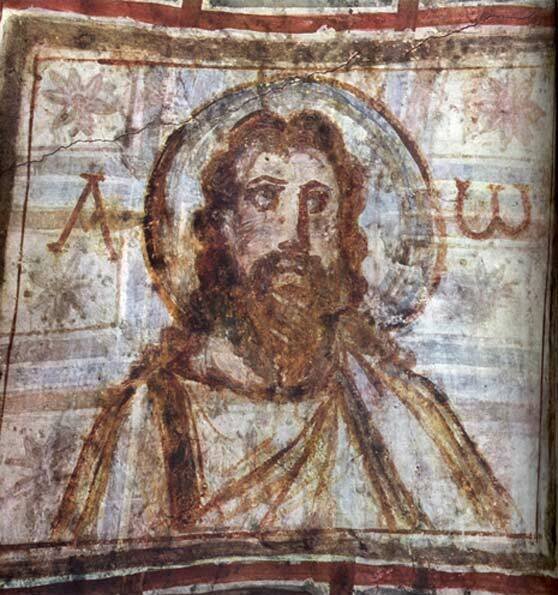
An underground basilica, shaft graves, well-preserved frescoes. This and more in the Catacombs of Commodilla, in Garbatella.
Rome is also famous for its catacombs, galleries dug into Roman tuff millennia ago and used by the newborn Christian community to bury their dead (to learn more click here). In this case, however, I would like to tell you about the Catacombs of Commodilla, in Garbatella, which can reveal multiple surprises that are hard to find in other catacombs. First of all, your tour guide in Rome tells you that here you can find shaft burials, that is, deep holes, up to 20 meters long, that extend in depth and feature numerous loculi, one above the other. Also interesting is how the Commodilla in question, although not officially a saint, in a fresco found here is depicted with a halo. Surely, as happened in other cases, Commodilla must have been a high-ranking woman, from a noble family, who donated her private land to the Church, which reused it to dig the classic tunnels for the burial of its dead. Probably, to make the task easier, an ancient pozzolana quarry was also reused, already used before and then abandoned. But now let's discover something more about these wonderful catacombs.

Always fascinating is to walk along the underground tunnels, imagining how in the past all the niches were sealed by slabs of marble and terracotta, with a mystical atmosphere given by the hundreds of oil lamps always lit, and by some occasional skylight left open to let light in and to provide an air change. This especially from the 4th century A.D. with the coming of Pope Damasus, who greatly expanded the cult of the catacombs themselves, which became places of devotion. And it is precisely to that century that we must look if we want to get to know up close the two main Christian martyrs who were buried here: Felix and Adauctus. Of course, as often happens with hagiographies of saints so ancient (mindful too of the fact that in that era, often, the hand was forced to try to find examples of pure faith that led, also, to death), the sources differ on the identity of the two. Some say they were brothers, but the story most widely told is the following. We are at the beginning of the 4th century A.D., during the last great persecutions against Christians, carried out by Diocletian. According to the Lives of the Saints, by Pedro de Ribadeneira, Felix was the first to be arrested and tried. As was the practice at the time, the condemned was given the chance to redeem himself, by perjuring and abjuring the Christian faith, embracing again belief in the pagan deities and in the emperor. Felix was therefore taken to the great Temple of Serapis on the Quirinal, and was ordered to pray before the statue of the god. But the man did none of this. He approached the great sculpture and blew. And with a loud thud, the magnificent work fell to the ground, shattering. The same scene also in the temples of Diana and of Mercury, with Felix who liked to repeat that the destruction of the statues happened because, these his words, “I did it by the will of God”. Needless to say, the sentence of death was now written. He was taken outside Rome, perhaps where today the Catacombs of Commodilla stand, and there he was beheaded. Before the beheading however, from the crowd packed in to witness the spectacle, a man stepped out, who cried out loudly “I too live under the same law as this man”. Having declared himself a Christian, he was then beheaded together with Felix, on the spot.
It is interesting to see how even proper names can change or transform over the centuries. No one knows the identity of the man who, scornful of danger and armed only with his faith, declared himself a Christian before the soldiers ready to kill Felix. He was an unknown man who had chosen to add himself to the sentence of death. “One who had joined in” is, in fact, the meaning of the word Adautto. The bodies were left there, without burial. As often happened, probably at night, other members of the Christian community gathered the remains, already considered almost sacred, to preserve them better. The Catacombs of Commodilla came to light in the 4th century AD, but they were enlarged under the pontificate of John I (first half of the 6th century AD), who reused the old pozzolana quarry, on the second underground level, to build a small hypogeal basilica, rich in well-preserved frescoes from the period. One, in particular, shows us Commodilla, and another still the Virgin Mary flanked by the two martyrs. As often happens, however, the catacombs were dedicated to more than one person. In this case not only Felix and Adautto, but also two martyr sisters and a certain Gaudenzia. All information to be taken with a grain of salt, since literary sources cannot always be precise, but the discovery of some burials is certain, some with well-preserved frescoes, which across the centuries remind us of the death, often brought about with violence, of men and women whose only fault was having a faith that, at that time, was not accepted by the authorities.