


Palazzo Lancellotti is a majestic 16th-century building whose soul, though wounded by the plundering it suffered, still recalls the good old days.
In the area of Via dei Coronari, the famous Roman street, today full of antique shops and art, which leads as far as Ponte Sant'Angelo and thus to St. Peter's Basilica, stands one of the finest buildings of Rome’s 16th century, a witness to the past stripped of most of its beauty, yet still able to tell us of a time when noble families, in Rome, competed to show their wealth. How? By building huge buildings. This is the case of Palazzo Lancellotti, which occupies an entire block, and which in 1583, at the wish of Cardinal Scipione Lancellotti, became a residence worthy of a prince of the Church. Follow your tour guide in Rome to discover how the palace may surprise you..
The Lancellotti settled in Rome as early as the fifteenth century. Only a century later, however, they had the good fortune to have a member who climbed the hierarchical and ecclesiastical ladder, becoming a cardinal: Scipione Lancellotti. A name haughty and pompous, which perhaps gives an idea of the figure we have before us. It was he who transformed the old family residence that stood here, among the alleys of Renaissance Rome, not far from the area where courtesans used to work in the city. He spared no expense, so much so that, to build this palace, architects of the stature of Francesco da Volterra and, later, Carlo Maderno were involved. Externally, seen from outside, the palace is rather austere, with a smooth façade and without too many decorations. That is why the two sacred shrines stand out and, above all, the portal on the main side, a work by Domenichino, flanked by two small columns. And on one of these there is a peculiarity that makes Palazzo Lancellotti special. If you look closely, in fact, on the smooth surface of one of the columns at the entrance there is an engraving: V.V.E. This is an acronym that stands for Viva Vittorio Emanuele, first king of united Italy. A tangible sign, probably left in 1870 or shortly after, of the political and historical upheaval that Rome underwent, which went from being capital of the kingdom of the popes to capital of the Kingdom of Italy. But it is inside that the palace displays all its beauty.
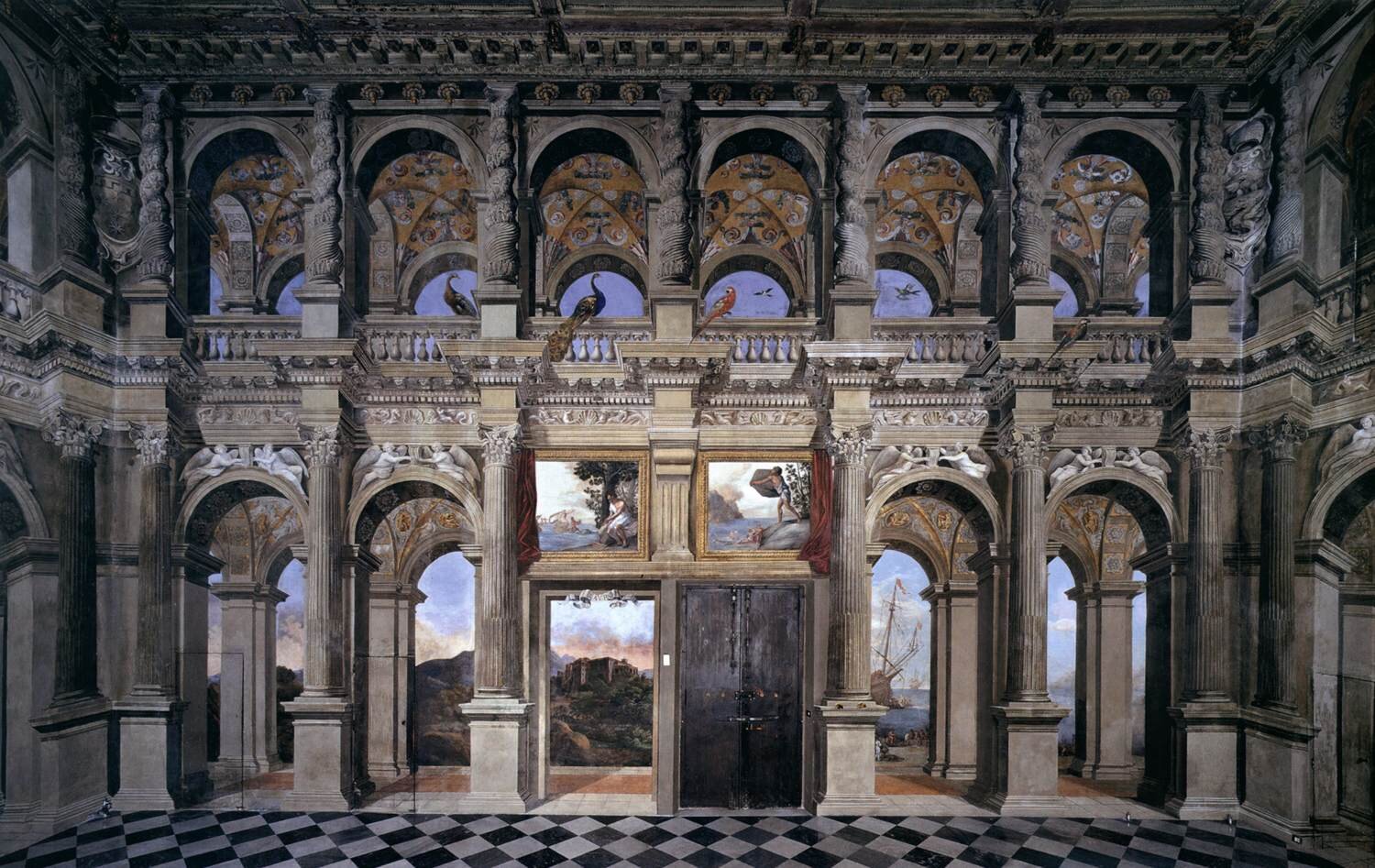
The inner courtyard rests on two porticoed levels, with elegant columns that lighten the whole setting, making it harmonious with the bulk of the palace. Similar, contemporary examples in Rome are countless: the inner courtyard of Palazzo Mattei di Giove or that of Palazzo Venezia, prototype of the Renaissance palace in Rome (together with that of the Cancelleria). Of course these spaces were richly adorned with works of art, of great craftsmanship, from the Roman period. At a time when the echo of the grandeur of ancient Rome, expressed above all in its marvelous works (especially sculptural ones), reverberated through the corridors of noble palaces, being able to decorate one’s princely residence with artifacts of the Urbe of old was almost a duty. So let’s not be surprised if works like the so-called Discobolus Lancellotti come from the family’s private collection. If you ever manage to enter the palace, you will also be amazed by the interior rooms, such as the grand hall adorned with extraordinary faux architectures (arches, balustrades, twisted columns), which reminds me of the splendors of the Triumph of Divine Providence or the perspectives of the namesake room at Villa della Farnesina. One last little curiosity. The Lancellotti were staunch defenders of the papacy, so much so that in 1870 they wanted nothing to do with supporting the newborn Italian government, instead of the pontifical one. Therefore they literally closed the doors of their wonderful palace, as if to say they no longer felt part of this city. Luckily for us, at least the historical memory of Palazzo Lancellotti remains more alive than ever.




















