Here's one of the little secrets of Rome, a place that could help you to understand how the Eternal City is also full of small wonders which are specials due to the legends and histories that are related to them! Trust a local tour guide when he says that off the beaten path, here in Rome, there are some remarkable things that should be known...
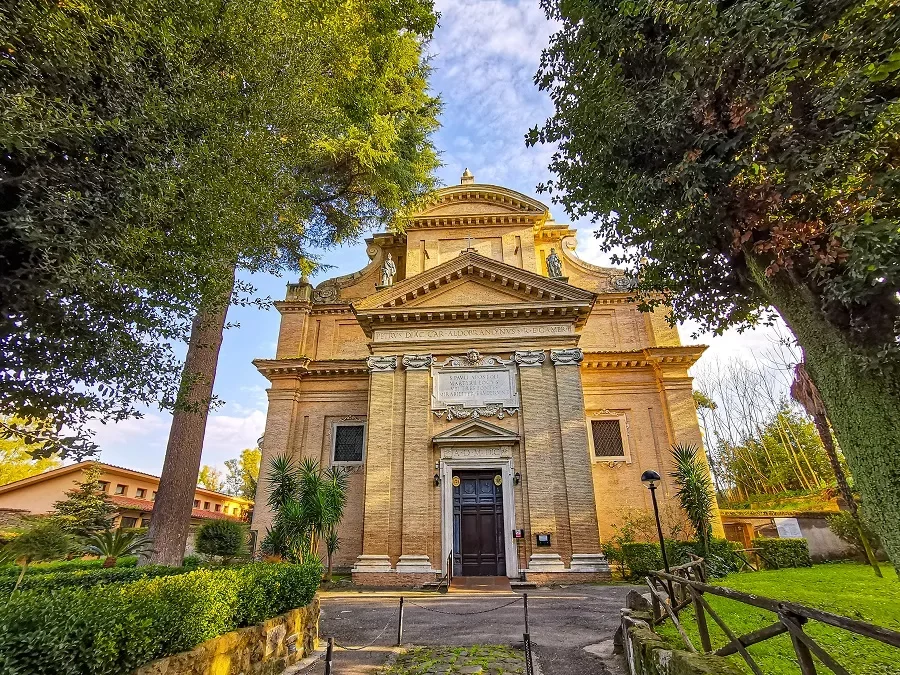
We are located in the urban stretch of the Via Latina, not far from the Porta San Sebastiano (near the Appian Way). As all the edges of the consular roads, the Via Latina, old as the more famous Appian Way or even more, is flanked by several tombs or funeral monuments from the ancient Roman time. Among the treasures that you can admire walking along the ancient pavement, we can find the medieval Basilica of San Giovanni at Via Latina (click here to know more), having close to it what you see in the photo: a small oratory dedicated to "San Giovanni in Oleo". Why this strange name? Here we talk about St. John the Evangelist, the one who had the famous apocalyptic visions of God and Angels, and the Trumpets of Judgment. St. John lived during the first century b.C., under the reign of Domitian. Being a christian in an empire of pagans, St John suffered a lot due to the persecutions and the tortures that he had! Among the tragic episodes remembered, there is one in particular: St. John would have been plunged, as you can see in the altarpiece which is located inside the oratory, in a cauldron of boiling oil. One of the cruelest tortures that you can imagine, one of the worst that were decided by the ancient Romans in order to torture a Christian. However, according to the tradition, St. John did not suffer any physical harm but, on the contrary, he came out rejuvenated. A clear sign of the power of God and how he can protect His children.
Not only that, because the people who were there during the tortures thought to be in the presence of a species of magician, a wizard with magic powers. And perhaps for fear, they gave him freedom. It was as a result of this miracle, in fact, that Domitian decided to exile St. John, who fled to the island of Patmos, where he had, in fact, his visions. Legend and tradition wants that, where it stands today, this sixteenth-century oratory, built in the course of some restorations who had flocked to the adjacent basilica, St. John knew his excruciating torture. A small oratory which, architecturally speaking, has are very important "fathers": in fact imagine that even Bramante, in the early ‘500, designed maybe the project (and he was the best architect of the beginning of the Renaissance age). While we know for certain that a hundred years after Borromini, the Baroque master, will put his art at the service of this little oratory, to restore it and make it pretty. Enter the inside means, therefore, to understand the sacredness of a place considered by the faithful as an example of divine salvation, and not only.
I leave you with the words written in the Legenda Aurea, which describes the torture suffered by St. John: “When the apostles after Pentecost, they separated, he [John the Evangelist] went to Asia, where he founded many churches. When the emperor Domitian was aware of his fame, made him come to Rome and made him throw it in a container of boiling oil, immediately in front of the door in Latin: but John does left it unharmed, as had been a stranger to the corruption of the flesh. The emperor, seeing that even so it withstood the preaching, sent him into exile on the island of Patmos, where, in complete solitude, and wrote the book of Revelation.”