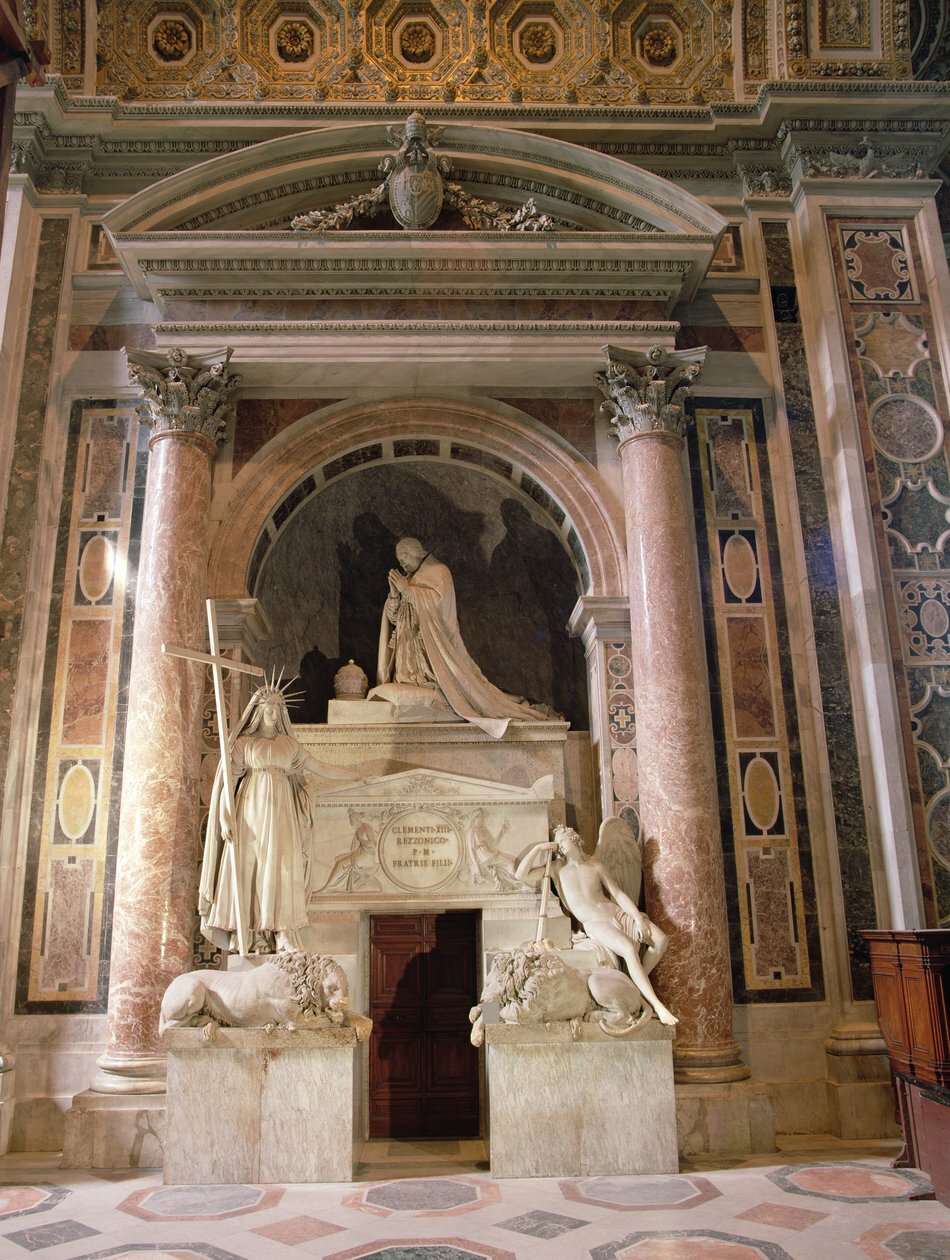
In the area of the Altar of the Confession in the Basilica of Santa Maria Maggiore in Rome, right in front of the reliquary containing remains of the manger of Jesus, a large marble statue shares that sacred space with you. Another example of how a simple sculpture can open up an entire world, so much so that in this case I can tell you that the statue can take us back in time, to a decisive moment for the modern history of Rome.
Here in the Basilica of Santa Maria Maggiore, in fact, we have the sculptural depiction, by Ignazio Jacometti, of pope Pius IX. He was elected pope in 1846 and remained on the throne of Peter for more than 31 years (he died in 1878), so that even today his pontificate is the longest in the history of the Christian Church after that of Saint Peter, the first pontiff. An energetic and cultured man, he went down in history as a pontiff who tried, in every way, to pull the Catholic Church out of the shallows caused by republican, constitutional and liberal backlashes that shook the European status quo during the 19th century. At that time, in fact, following the French Revolution and the hold those ideals had on many, all the historic European monarchies found themselves in difficulty. In Italy movements and more or less secret associations, such as the Carbonari, tried to overthrow in particular the age-old temporal and theocratic power of the Catholic Church, considered by many a symbol of obscurantism and dogmatism. When Pius IX was elected pontiff, however, at first he showed attitudes close to these liberal uprisings, which aimed to establish constitutions along the lines of the French one, completely overturning the power and privileges of individual kings, ruling families and the clergy. Often these impulses turned into revolts and revolutionary attempts. It was Pius IX who granted amnesty to those who were in prison precisely because of these revolts, just as it was Pius IX, at first, who “modernized” the Papal State: freedom for the Jews, construction of roads and railways, freedom of the press. We owe him, for example, the railway stations of Termini and that of Porta Maggiore, the latter today an important tram hub. We also owe him the building of some bridges, such as the so-called Iron Bridge, at the time considered the non plus ultra of industrial architecture. But it is when one speaks of his liberalism, of the amnesty granted and of the many freedoms, of expression and of the press, that Pius IX initially put in place, that one can understand how the pontiff represented a dream come true. A waking dream for those who dreamed of a new world.
A dream that shattered with the revolutionary uprisings of 1848, which saw Milan above all as the protagonist. Unlike others, however, the pontiff did not send troops in support of the Milanese population, which had become a symbol of freedom and struggle against monarchy and tyranny, in this case the Austrian one. It was the beginning of the end. The Roman people, but also many of the papal guards and the men assigned to police services, did not look kindly on this radical change of attitude. They expected a Pius IX ready, with his own armies, to lend a hand to those strong-spirited men who, in order to free themselves from the yoke of monarchy and oppression, were even ready to sacrifice themselves. All in the name of freedom. Pius IX, however, chose precisely a wait-and-see policy. Following his ambiguous behavior, tempers in Rome heated up to such an extent that the pope had to flee, dressing as a simple priest, and taking refuge in Gaeta, at the time within the Kingdom of the Two Sicilies. Pius IX was initially confined in his residence at the Quirinal, and only his quick thinking, and the poor preparation of the men who were supposed to watch him, led to his escape.
The Pope’s response, however, was not long in coming because, thanks to the support of the French army, he returned to the city (after 17 months). And here he harshly repressed every other revolutionary act, erasing from history the newborn Roman Republic and restoring certain practices, such as the death penalty, that smacked of the old regime. The French fought in Rome against the exponents of this Roman Republic which, in many respects, was a true political and social laboratory: inspired by the ideals of the French Revolution, in fact, the newborn Roman Republic provided Rome with a real Constitution, as it had never had. The locals, however, began to think very badly of Pius IX when the first French bombs destroyed some homes, and cut short some lives, in Rome. The city’s inhabitants began to exclaim, on hearing the explosions caused by the ordnance: "Here’s a Pius the Ninth". The pope, in fact, seems to have had no more scruples, ordering the French to do everything in order to win back his place. Certainly many were the difficulties faced by Pius IX who, among other things, did not fail to officially reaffirm the infallibility of the pope who, inspired by God, had necessarily to act always in the right. Perhaps for this reason the statue presents us with a humble and calm pontiff, with a relaxed face turned to prayer and to the search, perhaps, for a definitive solution to the political and social changes underway. A pope with two faces, in short, perhaps a victim of events, of whom we certainly know one thing: he was the last pontiff of the Papal State, definitively abolished with the Capture of Rome in 1870 by the new Kingdom of Italy and King Victor Emmanuel II.