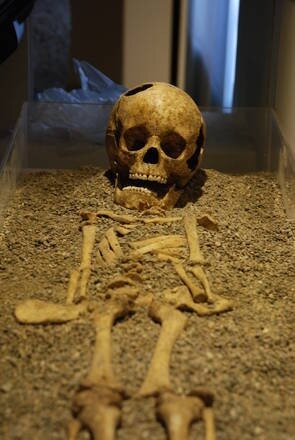

What is this skeleton showing a large hole in the skull, moreover perfectly preserved? We are in the Museum of the History of Medicine of La Sapienza University in Rome (which I’ll take the chance to promote, since it’s also free), and this is the masterpiece of its collection: the Child of Fidene.
This macabre skeleton belonged to a child, we don’t know whether male or female, dating to the 2nd century AD. The find was discovered at Fidene, a small town not too far from Rome which, at the time, was an area inhabited by some nobles of the Urbs but, above all, by shepherds and craftsmen. The child probably belonged to the family of some freedman who, with the right contacts and investments, had managed to hold a fairly important role in the quiet town of Fidene. In this beautiful and, sadly, little-known museum, the burial has been reconstructed, just as it was found by the archaeologists. What immediately catches the eye is, of course, the large hole in the skull. What does it represent? A clear surgical procedure! Nothing strange, since even today in surgery cranial holes are made to reduce brain pressure or for actual operations. What is special, however, is that already two thousand years ago there were attempts in this direction. Incredible that already in 2nd-century Rome, surely a golden age for all Roman civilization, they could go that far. A cranial trepanation used, certainly, as a kind of palliative. According to paleontologists, the child’s skull was larger than normal, and this caused severe headaches or a sense of nausea. The little one probably had a brain tumor, an illness that caused him atrocious pain. To try to do something, or more likely only to give a little peace to a patient already condemned to death by the disease, it was decided to perform a very complex procedure: remove part of the skull, so as to reduce internal pressure and give the child a little relief. Strikingly, according to the tests, the child continued to live for another month after the operation. New bone material, in fact, was found along the edge of the hole, showing how the child had, with strength, kept on living. Another great surprise, then, that leads us to think this find is truly one of a kind.
A glimpse of humanity, but also a way to understand how advanced, in one way or another, the medicine of the time was. The poor Child of Fidene from the Museum of the History and of Medicine at La Sapienza University in Rome is a symbol of how far doctors could go in operating. It seems, in fact, that the neurosurgeon in question managed to remove the cranial section in complete calm, with a steady, confident hand. It is also likely that it certainly wasn’t the operation that killed the child—quite the opposite! There are no signs of physical stress following the trepanation; rather, many are the signals highlighted by the paleontologists indicating that numerous infections struck the child’s body after the procedure. Although the wound had probably been bandaged, the Fidene child likely died from complications after the operation, not so much from the disease itself. And despite the care of competent doctors, unfortunately, death came all the same.