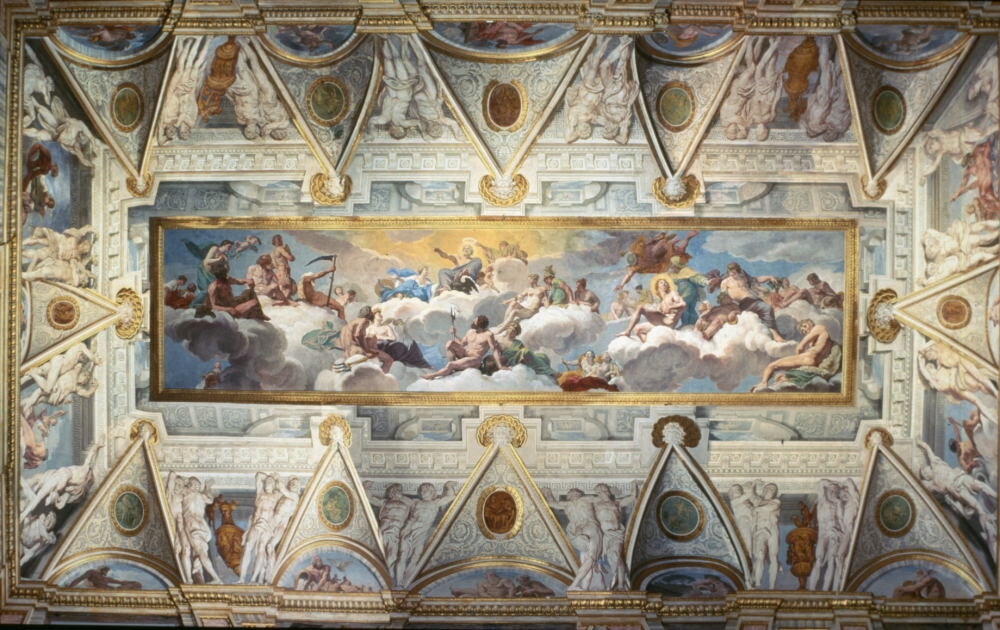
When I go to the Villa Borghese Museum with tourists I always advise them to admire not only the works of art on display but also the rooms which, themselves with their frescoes, are true jewels. The room that houses Bernini’s magnificent David, for example, is also called the "Hall of the Sun" because of the splendid central fresco, painted by Francesco Caccianiga in the second half of the 1700s, which tells us one of the most shocking and powerful myths in all Greco-Roman mythology: the fall of Phaethon.
He was a son of Apollo who, after learning from his mother who his real father was, resolutely decided to go to the heavenly palace of the God of the Sun, to meet him and claim his role as son. Kept in fact from birth unaware of his true origins, he decides to show his divine father what he would truly be capable of. Having arrived before the God of the Sun, he then asks his father to swear that he would allow him to do whatever he asked at that moment. Apollo, unaware of the true intentions of the newly met son, gladly agrees. Phaethon, however, sinning through pride, asks him to be allowed to drive, at least once, the Chariot of the Sun! An outrageous request that Apollo, bound by an oath that not even a deity could break, can do nothing but grant. He knows perfectly well that no mortal could ever make the Sun complete a full circuit and even for him, its guardian, it is not easy. He warns Phaethon, tries to make him change his mind, telling him what dangers he would face. But nothing, nothing convinces him.
Despite everything, then, Phaethon sets out the following morning driving the chariot drawn by four fiery horses, who know as their only food the divine ambrosia. And immediately afterward he realizes he is utterly unable to tame them, losing control and creating total chaos! Ovid, for example, tells how the sky literally caught fire, how the Ethiopians became dark-skinned because of their too-close contact with the Sun, which went up and down across the sky without following a precise route. Ovid even says that the Nile, frightened by such chaos, decided to hide, preventing anyone from understanding where it originated (a way to justify the fact that at the time the source of the Nile was unknown). In short, a real disaster, which Jupiter brought to an end by killing Phaethon with a lightning bolt ("But at that moment he [Jupiter] had no need of clouds to cover the earth, nor of rain falling from the sky: he thundered, and raising a lightning bolt high on the right, hurled it against the charioteer [Phaethon], casting him from both chariot and life, and with the fury of fire he checked the fire"). A myth powerful in its emotions, those of Apollo trying to persuade his son by also telling him of the fears and the grip on the heart that he himself feels every time he must tame those four horses, as well as the anguish felt at the loss of his son because of Jupiter. Something that, by raising your eyes to the sky after seeing Bernini’s David, you too may grasp...