

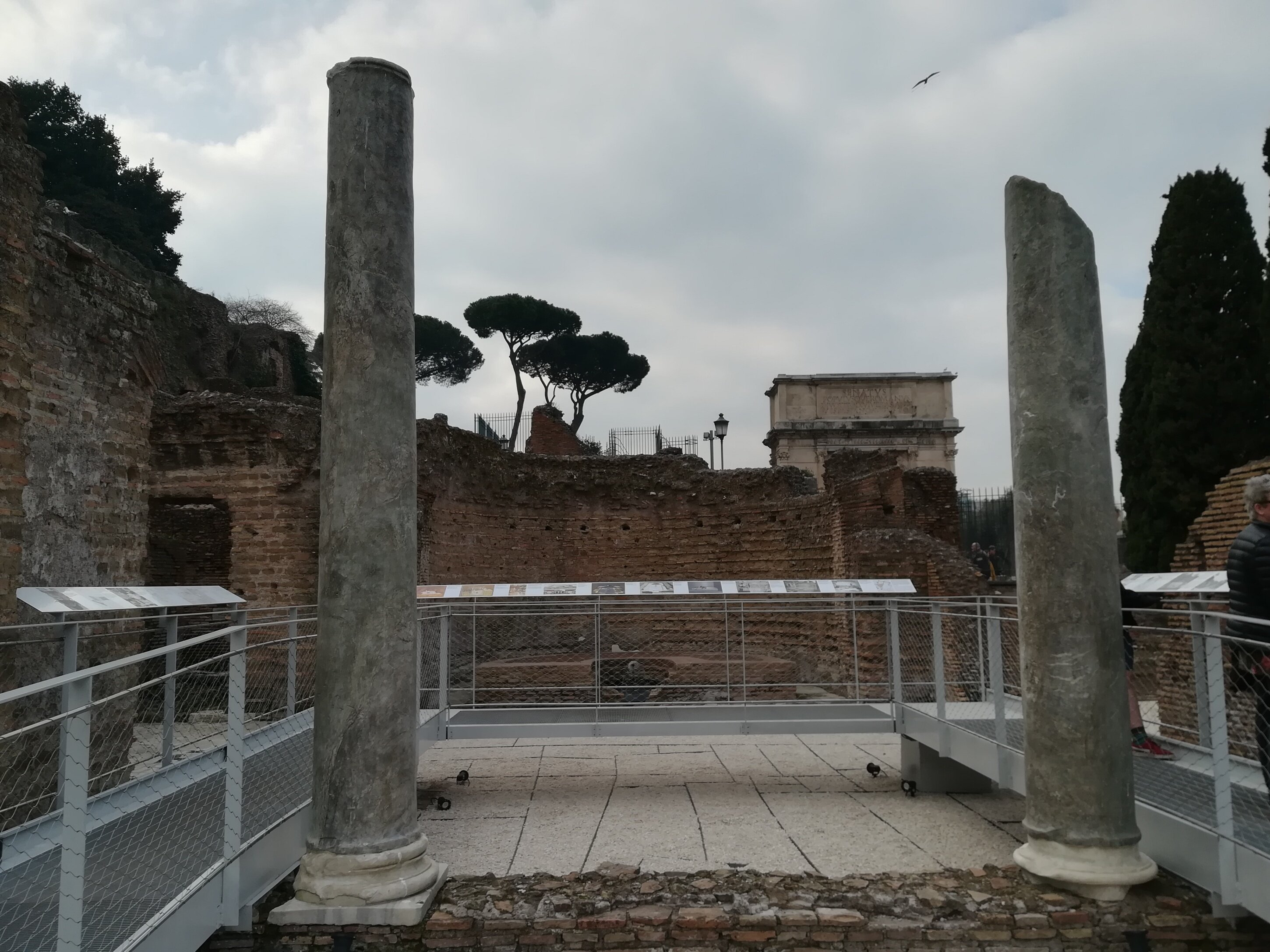
In the photos, some snapshots of the so-called area of the Baths of Elagabalus, recently opened to the public and located between the Arch of Titus and the slopes of the Palatine, on the Colosseum side. Numerous excavations have been carried out in the area in recent years, actually resuming archaeological work already started in the nineteenth century. Today we see only a few ruins here and there, a couple of columns erected in the center without any historical basis (just for show, so to speak), but also other very interesting elements to understand what was really here. As always, however, it is good to understand the stratification of the Eternal City and the continuous surprises that emerge from an area dense with history and buildings like the Roman Forum and the area including the Palatine as well. So today, with your tour guide in Rome, let's go discover something new.
As with everything concerning Rome, in reality the area has undergone a very long evolution, starting from the 1st century AD when something was already present during the Julio-Claudian dynasty. Much changed with Emperor Septimius Severus who, initially, was thought to have modified pre-existing structures (such as shops) transforming them into a horreum (warehouse for foodstuffs consisting of a courtyard surrounded by columns and a two-story building). Here the name given to the structure, Baths of Elagabalus, also comes into play. In reality, it is a sort of invention, since the name dates back to the late nineteenth century when, from a document, it emerged that the emperor would have opened a lavacrum in the area. The hypothesis was strengthened when it was discovered that there were basins in the area, probably filled with water. But then everything changed and the real intended use of the building was discovered. Since the 4th century AD, reusing the structures of Septimius Severus, a rich domus was built here, also featuring a caenatio. This is a room with semicircular benches where guests could sit, nibbling on food here and there, in front of a beautiful basin filled with fresh water! A sort of paradise meant to honor the guest and highlight the opulence of the master of the house. Yes, but whose domus was it, also featuring an external peristyle with another basin and columns? We don't know, although we have some archaeological clues.
Years ago, right here, what are believed to be the military insignia of Maxentius were found (you can read in detail by clicking here), the enemy of Constantine defeated by the latter at Ponte Milvio in 312 AD. The insignia were well arranged and hidden, not thrown in haphazardly. If true, then, Maxentius would have had them placed in a house of his trust. Maybe it wasn't really his house, but perhaps one of his private properties. Who knows...





















