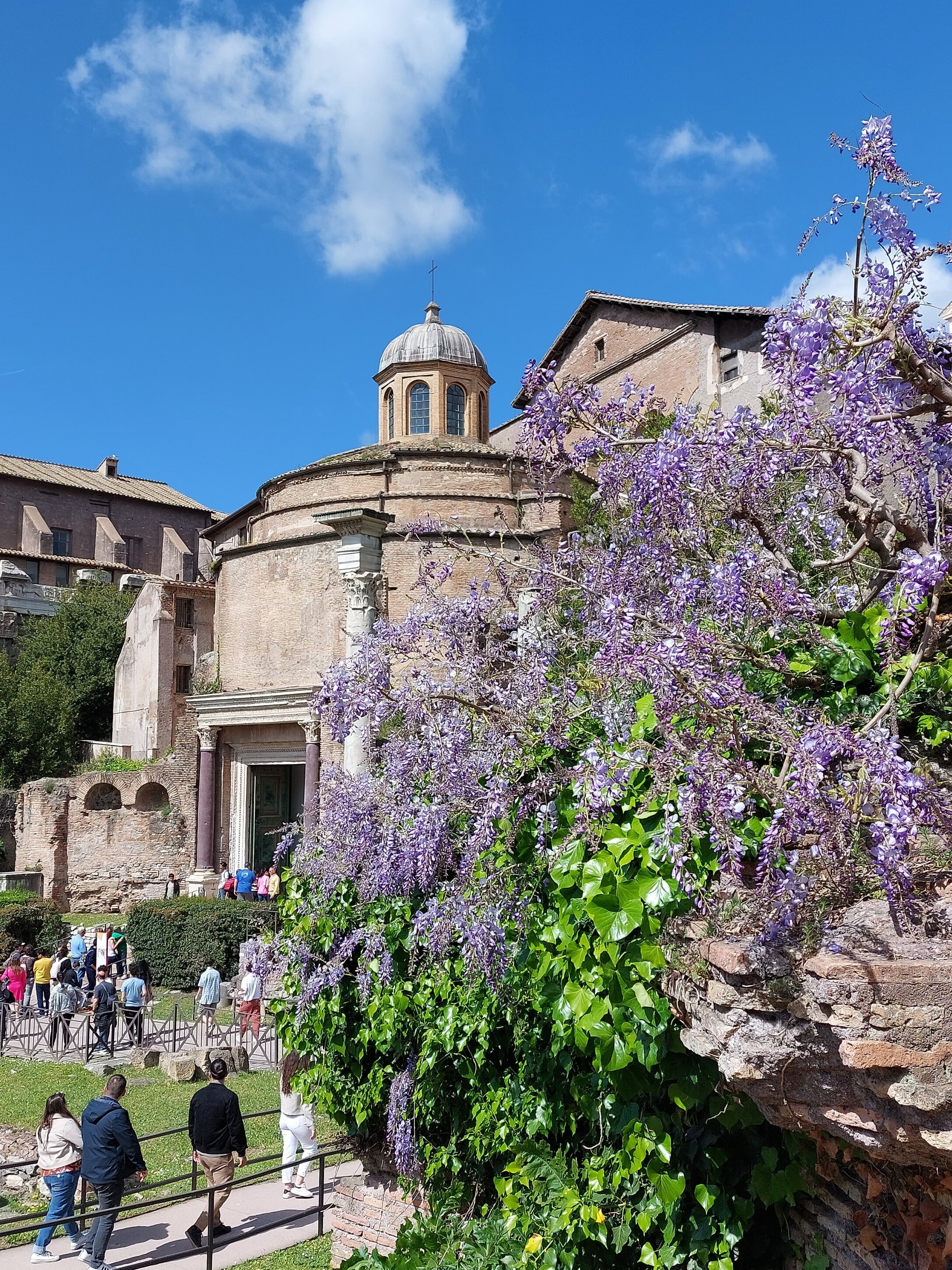
Often bypassed by tourists who, walking along the Via Sacra (used in the past for extraordinary triumphs, as you can read here), are captured and inspired by the beauties of the Roman Forum, the so-called Temple of Romulus has a lot to say. This is one of those buildings in Rome capable of symbolizing an entire understanding, of making us understand why the Eternal City is so particular and historical, from all points of view. I am often here for a tour, and as a tour guide I can tell you that it is worth stopping for a while in front of this rounded building.
Theories regarding its attribution are controversial, which is commonly indicated as the temple of the Divine Romulus, son of Maxentius who, following the death of his son at a young age, decided to use a vestibule of the ancient Forum of Peace to create a place of worship. We are in 309 AD, a difficult period for Rome with the creaking tetrarchy and with an impatient Maxentius, ready to take power in Italy. He will succeed, for a short period of time, despite the death of his son who, however, in imperishable memory, he will make divine, as was the custom of the time . However, it is interesting how the temple complex follows the history of Rome. After the defeat of Maxentius (of which we have direct remains, it seems, thanks to some of his military insignia found and preserved in Palazzo Massimo alle Terme), it was the victor Constantine who took charge of the temple, perhaps changing its function . We then arrive at the 6th century AD, when King Theodoric donated a library of the Forum of Peace to the pope, who transformed it into the first nucleus of the church of Saints Cosmas and Damian. In doing so, the temple of Romulus became the vestibule of the church itself. It should be remembered that the bronze portal, due to its reuse over the centuries, has miraculously remained intact since the 4th century AD! A true miracle for such a large bronze piece, a material often reused over the centuries. But also the marble friezes that run around the door, and the red marble columns are original from the time. In this case we see how the reuse of ancient templar buildings did not lead to a complete destruction of the original architectural elements (as, also, in the case of the nearby Temple of Antoninus and Faustina).
Probably if this temple had not been incorporated into the new building of Christian worship, it would have been lost forever. Finally, it is interesting to know how the attribution of the so-called Temple of Romulus is in strong doubt, and how sometimes we have to trust very tenuous testimonies to attribute or know something about our past. There is, in fact, only one coin, minted by Maxentius, with the writing aeterna memoria and with a circular building on the other side to indicate to us that, perhaps, this is the temple of Romulus written in other sources... Who knows!