

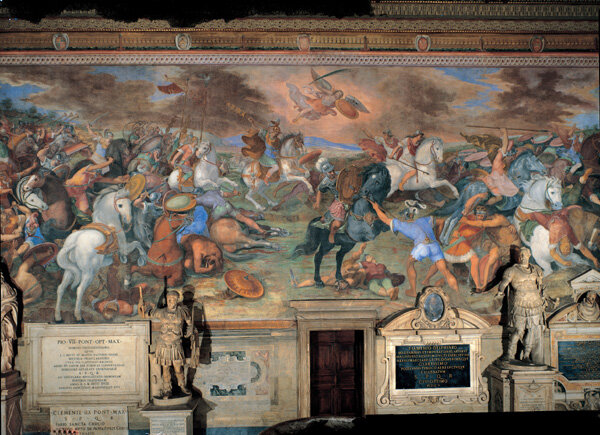
Here we are again at the Capitoline Museums, which have surprised us more than once with immortal works, such as the bust of Commodus or the famous Lupa Capitolina. But let's not forget that the main building which houses the immense collection of the Capitoline Museums in Rome, which as a local tour guide I advise you to visit more than once, is a sixteenth-century palace. And, among other things, it was also the seat of one of the most important civil and secular offices of the Rome of the popes. It goes without saying, therefore, that it should be honored with the art of great masters. We have an example with this one by Laureti (16th century) representing the Battle of Lake Regillo. Colors and dynamism that tell us, in the Sala dei Capitani completely frescoed with scenes taken from the ancient dawn of Rome designed to underline the victories and virtues of the city, one of the first and epic battles fought by the newborn Republic. Let's see how.
We do not know exactly when or where the Battle of Lake Regillo took place. Perhaps near Montecompatri, perhaps near Tusculum, and probably in 496 BC. We know for sure, however, that following this battle Rome, for the first time, was able to rule the whole region around its young borders. By defeating the neighboring tribes, which united in the so-called Latin League to defeat the increasingly pressing and worrying hegemony and presence of Rome, the Urbe will experience its first real territorial expansion. Let's follow what Livy tells us, to get an idea (although we don't always have to hang on the historian's words) of what happened. It all began with the expulsion of the last king of Rome, Tarquinius Superbus. The latter wanted at all costs to try to take back the throne, and for years he organized various alliances with foreign kings and with tribes who knocked on Rome's doors. It seems that the last king could also count on some consensus in the city, with people who preferred the kingdom to the republic. The fact is that Tarquinius convinced his supporters and allies to put together an army which apparently consisted of about 40,000 infantry and 3,000 cavalry. Rome, with its two consuls in command, including Postumius, could count on 24,000 infantry and 3,000 cavalry. The fight seemed unequal, and in fact when in 496 BC the two armies collided head-on and in an open field, Rome began to suffer numerous losses. But it was precisely the cavalry, which Rome never really loved considering it the weak part of an army, that gave a big hand. Tito Livio tells us that Postumio ordered his knights to dismount and fight together with the infantry. With heroic courage the Romans, more accustomed to hand-to-hand combat , managed to defeat their enemies! Furthermore, to sanctify the victory, it seems that Rome had also a divine help! As if out of nowhere, two strong young men riding their tough white steeds fought in the front line, routing the enemies and giving a great deal of courage and courage to the Roman soldiers in difficulty. After the battle, the two returned to Rome, announcing the victory , watered the horses at the Fonte di Giuturna and disappeared. Who were the two? Castor and Pollux, sons of Jupiter, divinities to whom Rome had dedicated the sacred territory of the city. When needed, the Gods descended on Rome's side, and this could only please the Roman generals who, obviously, took any possible help very much to heart, especially of a divine nature.
In fact, Tito Livio narrates that "At that moment, it is said that the dictator [Postumius], in order not to neglect any divine or human help, dedicated a temple to Castor and promised prizes to the first two soldiers who entered the enemy camp ”. Not a bad incentive, just as not at all negligible was, according to tradition, the help from heaven which allowed the city to defeat its enemies. As always, in the official Roman historiography, myth and history blend perfectly to legitimize and justify the military, but also cultural and social domination that Rome had over all subject populations. And this fresco, masterfully painted in one of the halls of the Capitoline Museums, reminds us very well what the Urbe is, after all: a mix of legend and reality.





















