

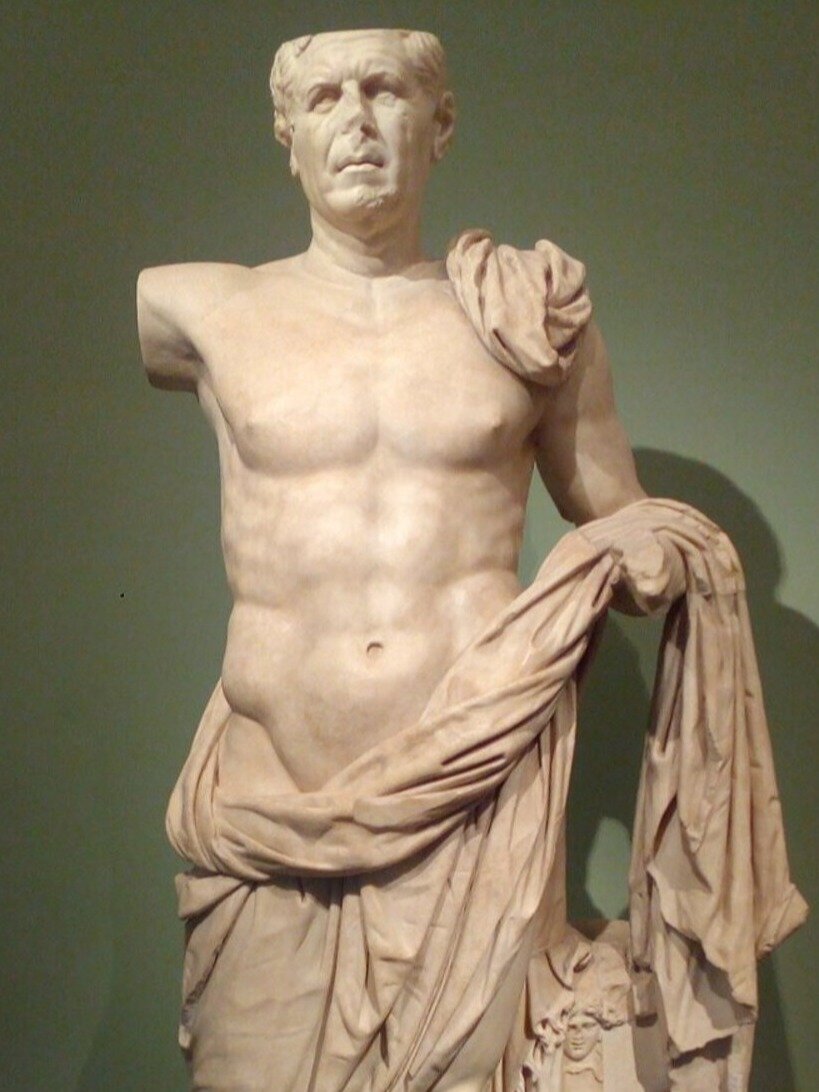
Let's go back to Palazzo Massimo alle Terme ì, let's go back to one of the most beautiful museums in Rome with a unique collection in the world ì. Well, today your tour guide of Rome tells you about and exhibits a masterpiece of classical art, or rather a sculpture that can, in effect, be a model for what the art of the past knew how to communicate and show. Here, then, is the picture of the so-called General of Tivoli, a Roman sculptural work from the 1st century b.C.. Let's get to know it together.
Found following some excavations in the famous Temple of Hercules in Tivoli, it represents the non plus ultra of Roman art and portraiture of the late Republican age. We have an elderly man in heroic nakedness, with some missing pieces, a fine drapery to partially surround him and a cuirass at his feet. Thanks to this element we can understand that it is a general, a strong and experienced man of arms, capable of anything! His face is very realistic, the wrinkles and baldness give a sense to his maturity, just as his proud gaze gives the idea of a resolute man. All stylistic and physical elements that highlight the figure of man, both within the Roman community and in his personal deeds. This extreme realism merges with the idealizing search for perfection of the Greek-Hellenistic tradition, which allows the general to fulfill one of his wishes: to look like a hero. The strong muscles, the probable spear to which it had to be supported in the typical attitude of the Hellenistic princes, not to mention the gorgoneion depicted on the armor (the head of Medusa used, often, as a warning to scare enemies or for protection). In short, in a simple work of art two traditions that merge: the Roman one in the perpetual search for realism and self-realization, and Greek linearity , beauty and perfection . The second, of course, had to actually contribute to achieving the primary objective: the celebration of oneself and one's virtues .
A self-celebration in Roman sauce, however, seasoned with the maturity of Greek art. A mixture of styles and intentions, an example of how ancient civilizations knew how to influence each other, not only with weapons and markets, but also through the arts. The General of Tivoli at Palazzo Massimo alle Terme in Rome , therefore, shows us the beauty of artistic creation, and how often, yesterday as today, art is subjected to politics and human voluptuousness. Nice isn't it?





















