

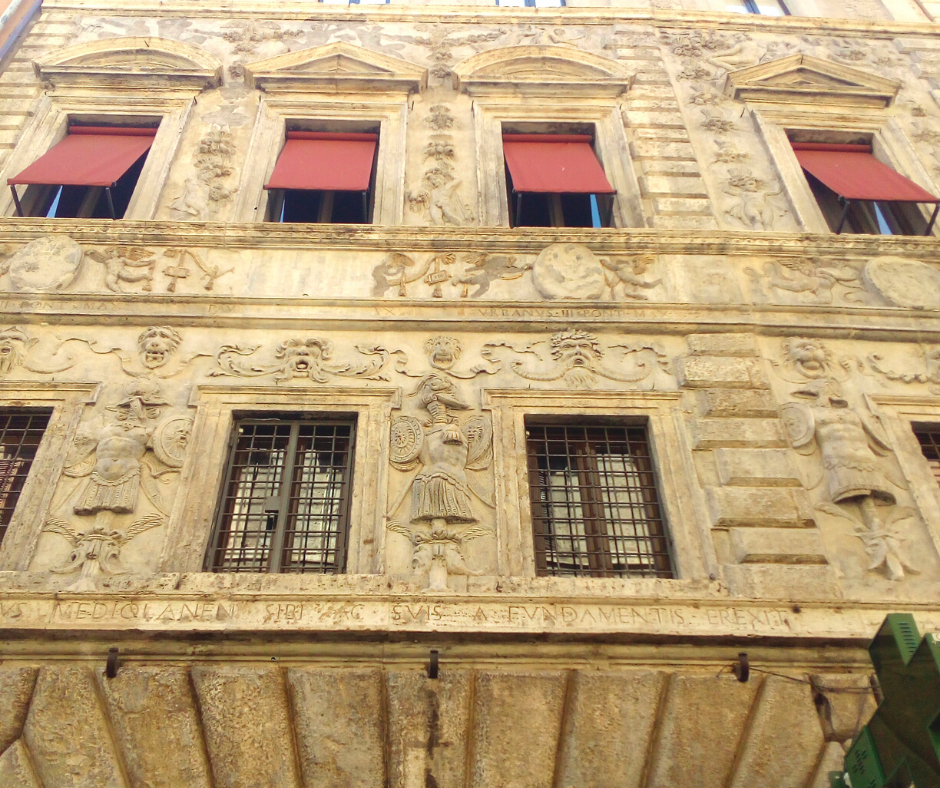
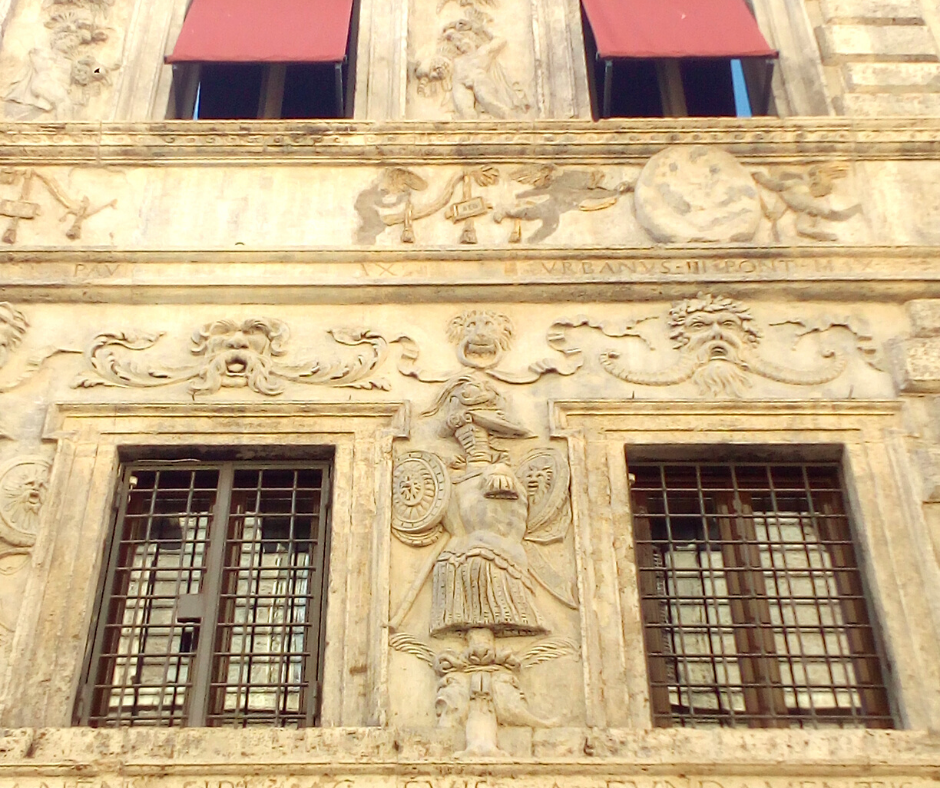
Walking around Rome can hold many surprises, such as when you walk along Via dei Banchi Vecchi (Campo de' Fiori area) and are fascinated by the stucco decorations, almost unique in the city , of this building . As often happens, just raise your eyes for a moment to be immersed in elements and decorations of other times, to be projected into glimpses of worldliness and beauty . Walking with my tourists I always like to stop here, to talk a little about the eccentricity and sense of taste of some people of the past .
In the photo see the facade of Palazzo Crivelli, built in the sixteenth century, also known as the Casa dei Pupazzi. The creator and inspirer of the building was its owner , a certain Gian Pietro Crivelli. A prominent personality in Rome, having been both consul and chamberlain , as well as a fine goldsmith. In short, a man who knew how to work precious stones, who had the right connections in the city, who knew who to turn to carry out architectural works of undoubted respect and who, above all, had a relevant artistic education with him. The whole building, and its beautiful decorations, have a clear self- celebratory intent (a bit like the ancient Romans), and to understand it it is enough to read the inscription placed above the central door, in which Crivelli places, in Latin , his name and his hometown (Milan). The facade, then, is a riot of stuccos, allegories and figurines that refer to the Greek-Roman translation, and to concepts such as abundance, victory and fun . Each single floor has a different decoration.
Thus, on the first floor we find a series of shields and cuirasses, complete with large masks, decorative frames and some papal coats of arms, including that of Pope Urban III who was a direct descendant of Crivelli. Obviously when you have such an important lineage, of such prestigious ancestors, it is a must to give them the right emphasis! Continuing further, on the second floor, we find pairs of satyrs around the windows, which begin to have different tympanums, so as to make the facade more eclectic. Finally, reaching the third floor, we notice scenes from the life of Pope Paul III Farnese, including the Emperor Charles V kissing the Pope's foot. A way to gain favor with the Pope? Maybe! What is certain is that, even today, the architect who created this decorative apparatus is not known. Strange to say, but sometimes even the wonders do not have a recognized creator, although what is really striking is the continuous reference to the same self-congratulatory language, typical of classical Roman art, which can be found in part, for example, in a sculpted group housed in the rooms of the Centrale Montemartini Museum. A bridge between the past and the present of the time that helps to embellish one of the buildings in Rome.





















