

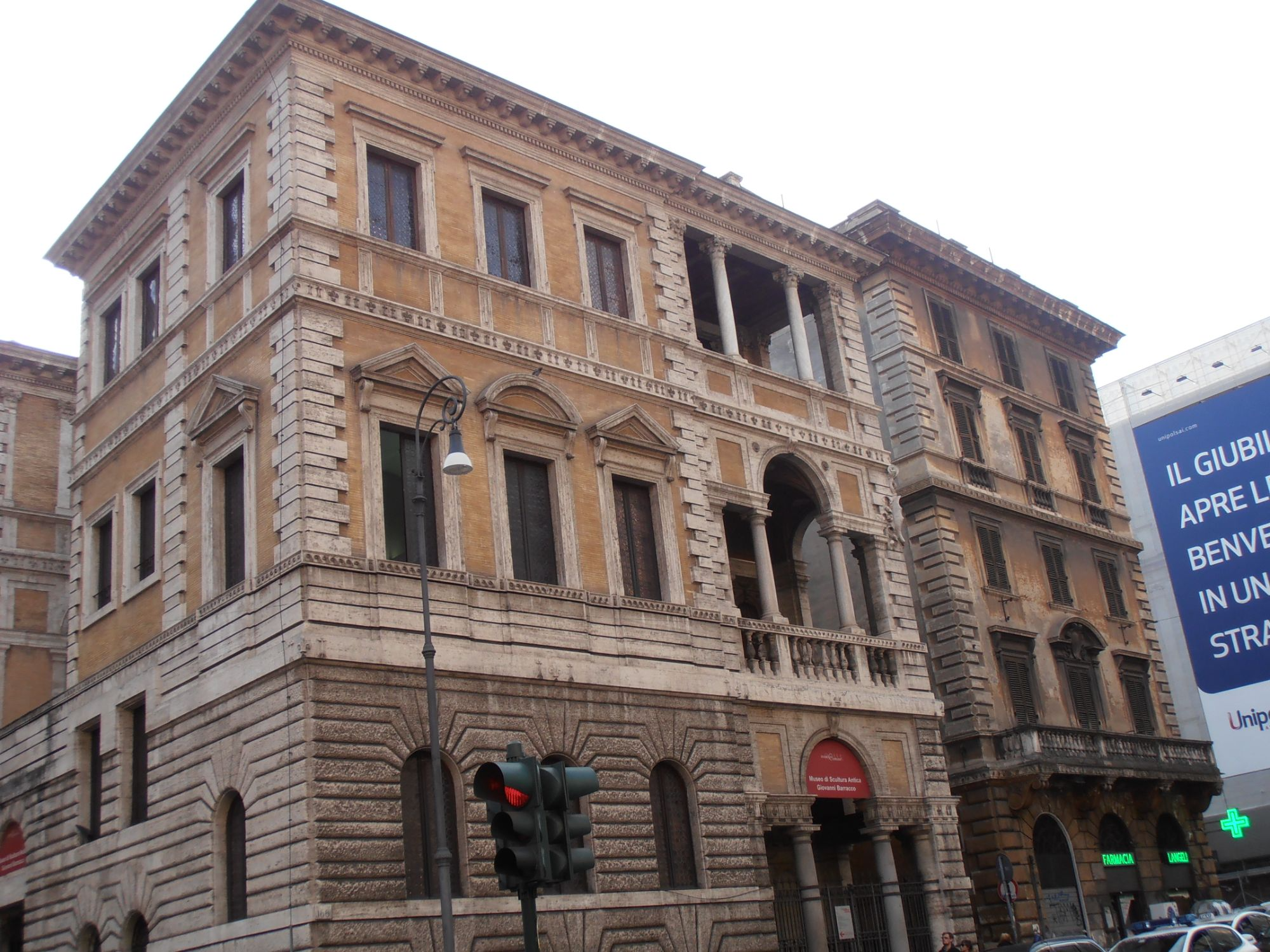

Today I'm going to talk about one of the most curious buildings in Rome, that also hosts the Barracco Museum (I recommend visiting it, as it is a museum housing rare pieces of Egyptian art, Mesopotamian, Phoenician, Greek and Roman): Palazzo Farnesina ai Baullari.
The palace itself is one of the most beautiful examples of renaissance art from an architectural and stylistic point of view, as it still surprises today with its elegant forms. One of the mysteries of the building represents its architect: in the XIX century it was rumored that it was even designed by Michelangelo (false), then by Raphael (false), then also by Giulio Romano (false), subsequently by Baldassarre Peruzzi (possible), and finally by Antonio da Sangallo the Younger (probable). The latter conceived this building following the physiognomy and style of Palazzo Farnese of Rome, a project on which the architect was able to work. A three-storey facade in this case, punctuated by framed windows and with a simple ashlar on the ground floor. But Palazzo Farnesina ai Baullari, also called Piccola Farnesina, hides much more, starting from what lies under its foundations...
In fact as often happens in Rome excavating for the restoration work a domus came to light. from the third century a.D., which develops, as usual, around a porticoed courtyard. Even today the frescoes found in the domus, detached from the original walls, are found inside the museum housed inside this delightful building. It should also be added that this building, certainly particular in the panorama of the neighborhood and the area, is one of the best examples of the demolitions and the great change that Rome underwent at the end of the 19th century, when, once proclaimed as the Capital of Italy, the city was subjected to numerous and often invasive transformations. The current Corso Vittorio Emanuele II was built and enlarged at the time, physically "detaching" the building from the adjacent buildings and planning drastic changes. In fact, the facade on the north side, the one that today looks onto the new course opened at the end of the nineteenth century, was built from scratch by the architect De Guy who, fortunately for us, had the good taste to maintain the stylistic and formal context of the others facades of the sixteenth-century building.
But Palazzo Farnesina ai Baullari of Rome has more to say, in particular regarding the curious name which, despite the centuries, is totally...wrong! In fact, one might think that this palace was one of the possessions of the Farnese family, and this derives from the numerous lilies, complete with ermine, which were typical of the famous family's coats of arms. It is a pity that the Farnese have nothing to do with it, since the building was commissioned by the Breton prelate Thomas LeRoy (latinized in De Regis), who used the lily as a symbol of France and the ermine as a symbol of Brittany.





















