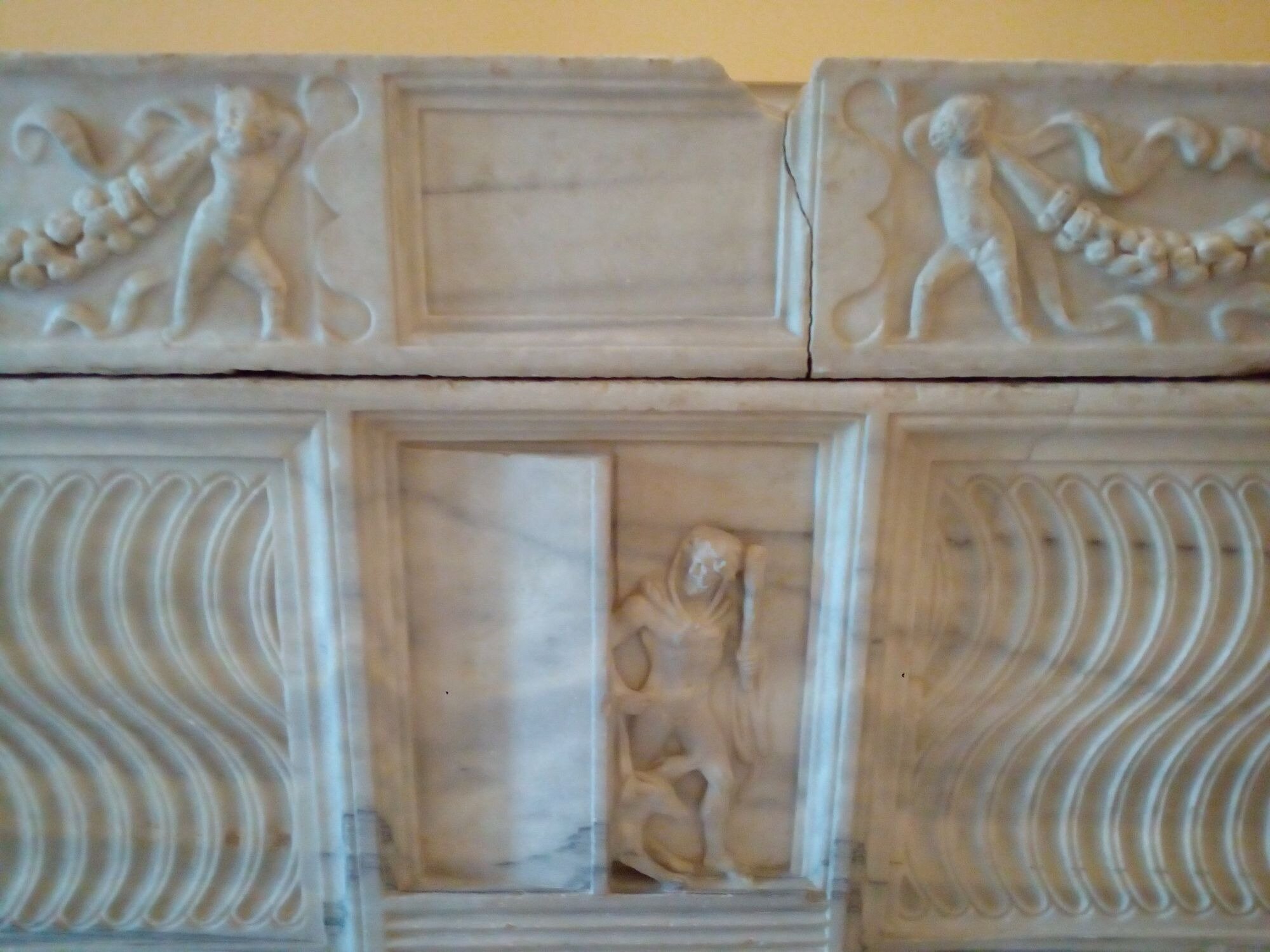
One of the small details, and treasures, of the Centrale Montemartini Museum in Rome is here, looking at the photo. A museum that has so much to offer, with works of art from the republican and imperial epochs immersed in the modern atmosphere of a former thermoelectric power plant! There is a lot of space for some marble coffins of the late imperial period (about II and III century), which make the job and life of a local tour guide really amazing.
In this period, so intense in a politically and culturally way, the roman society was passed through a moment of transformation especially as regards the funeral rites connected and, in particular, to the conservation of the bodies. The Romans began to be buried more and more and no longer cremated, as instead it was common practice until that time. Imagine that men like Julius Caesar, for example, were cremated and the ashes placed in an urn, precious in his case, as befits the style of his time. Then, however, the things changed, mainly due to the influx of new religious cults of oriental type, from Christianity to other ideologies connected to the land of Egypt or to the Far East, different cults that took hold on the soul of the Romans by modifying them in part the behaviors. Like many Mediterranean civilizations and beyond, at the dawn of Rome the dead were often simply incinerated: a direct way to reach the afterlife, as can also be seen in the famous epic poems (Odyssey and Iliad). Then, although the changes are never clear and often could coexist together, over the centuries we have passed to a practice such as burial, certainly more effective and, as far as Roman society is concerned, more expensive! Having similar coffins made for the remains of a family member was the stuff of the rich, and meant belonging to a particularly financially gifted clan or family. Moreover if a coffin was very well decorated was better, mainly to introduce the opulence of the noble family. For this reason the themes represented, although schematized in a series of recurring figures, can always be the same: Dionysus (divinity of wine but also of the resurrection, connected to our instincts but also to elements such as peace or joy), hunting or war scenes if the deceased was a living soldier or, as in this case, scenes from the famous twelve labors of Hercules.
The demigod symbol of strength and virility, but also protector of sailors and traders, complete with a leonté (the lion skin) and a club, which we see here crossing the Gates of Hell pulling poor Cerberus, the famous three-headed dog guardian of the entrance to Hades, was one of the favorite subjects for male burials! A curious way to say how much virtues such as strength were comparable to the deceased, and how much he himself can enter almost victorious, triumphant, into the Kingdom of the Dead. A mixture of styles and myths which, therefore, found natural outlet in this sarcophagus of Centrale Montemartini in Rome, a museum that I recommend to visit for the numerous works of art exhibited here and for the archaeological evidence, as in the case of this sarcophagus, capable to give us insights into the social life of the ancient Romans.