A masonry section and here the story of the first man who gifted public baths to the Romans of old is revealed, and he was not an emperor.
The good fortune of a city like Rome lies in its extraordinary ability to preserve its glorious past, especially from an architectural point of view. After all, the Romans of old were great engineers and, at times, it takes very little to realize it. Try, for instance, to stroll through the alleys around the Pantheon. One in particular: Via dell'arco della Ciambella. A peculiar name, no doubt, but what will catch your eye is a brick masonry section, with a vaguely circular shape, about 10 meters high. This is what, visibly, remains of the first public baths built in Rome. We owe this record to Agrippa, the famed friend and son-in-law of Augustus, as well as the man who, thanks to his military feats, helped the one who led Rome out of the Republic to embrace the Empire. After all, Agrippa, at the end of the 1st century BC, held a public office that allowed him to decide which buildings, even monumental ones, to build in the Urbe. Among these we count the nearby Pantheon and the Basilica of Neptune located behind it. Completing the renewal of this sector of the Campus Martius, the area where these three buildings stand, are the so-called Baths of Agrippa. Come with your tour guide to Rome to learn more.
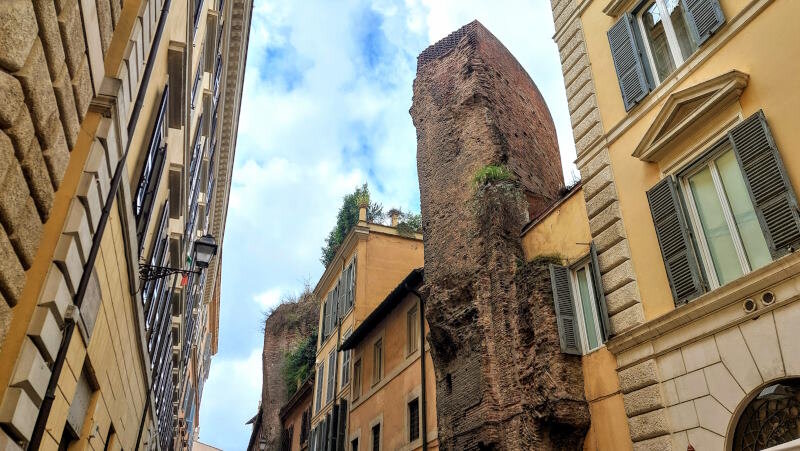
Let’s start with what was meant to be the building’s plan, which we know about thanks to a fragment of the Forma Urbis (click here to better understand what I’m talking about) and to drawings by men who, over the centuries, dug in the area for various reasons. At the time the classic layout seen in the great imperial baths, like those of Caracalla or Diocletian, did not yet exist. No sequence of calidarium, tepidarium and frigidarium. Basically Agrippa took private baths as his model, which were already all the rage at the time, especially among the well-off social classes of Roman society, making them more monumental. So, from the central hall with a circular plan—the one whose brick substructure is still visible in Via dell'arco della Ciambella—the other rooms branched off in a rather irregular way. In this area, and especially toward the Largo Argentina zone, archaeologists found the classic terracotta pipes used to carry water heated by steam. So, probably, in this part of the building it was possible to find the hot-water baths. After all, the function of the baths, especially public ones, was always the same: socializing and propaganda. Agrippa spent a lot of time and money to create something that would glorify Augustus’ newborn reign. Imagine that, probably, the works began in 25 BC, when the Augustan principate had only just been inaugurated, and ended around 19 BC. Why this year in particular? Because that was when the famous Acquedotto Vergine was completed.
Think about it for a moment. The baths had to be constantly supplied with water, right? And what better opportunity than to use a newly inaugurated aqueduct, able to keep the water flowing day and night for the Romans to enjoy? It’s no coincidence that, in the same area, Agrippa had the so-called Stagnum Agrippae built, a true artificial pool fed by the aqueduct. From here also branched off a channel, which then flowed into the nearby Tiber, used to direct the waters more effectively, ensuring continuous recycling and enviable cleanliness. Indirectly, part of this channel, known as the Euripus, is still visible today in the underground areas of the nearby Palazzo della Cancelleria (which you can learn more about by clicking here). Thus the baths, commissioned by Agrippa, played an exceptional role in redeveloping the whole area of the Campus Martius, a district to which Augustus paid great attention. The baths themselves, after all, were to be adorned not only with wonderful polychrome marble slabs, but also with extraordinary works of art such as the Apoxyomenos by Lysippos. A multifunctional building, then, probably also equipped with areas set up for gymnastic or intellectual activities. Something that brought honor to Agrippa and Augustus, still partly visible today while strolling, peacefully, through the alleys of Rome.