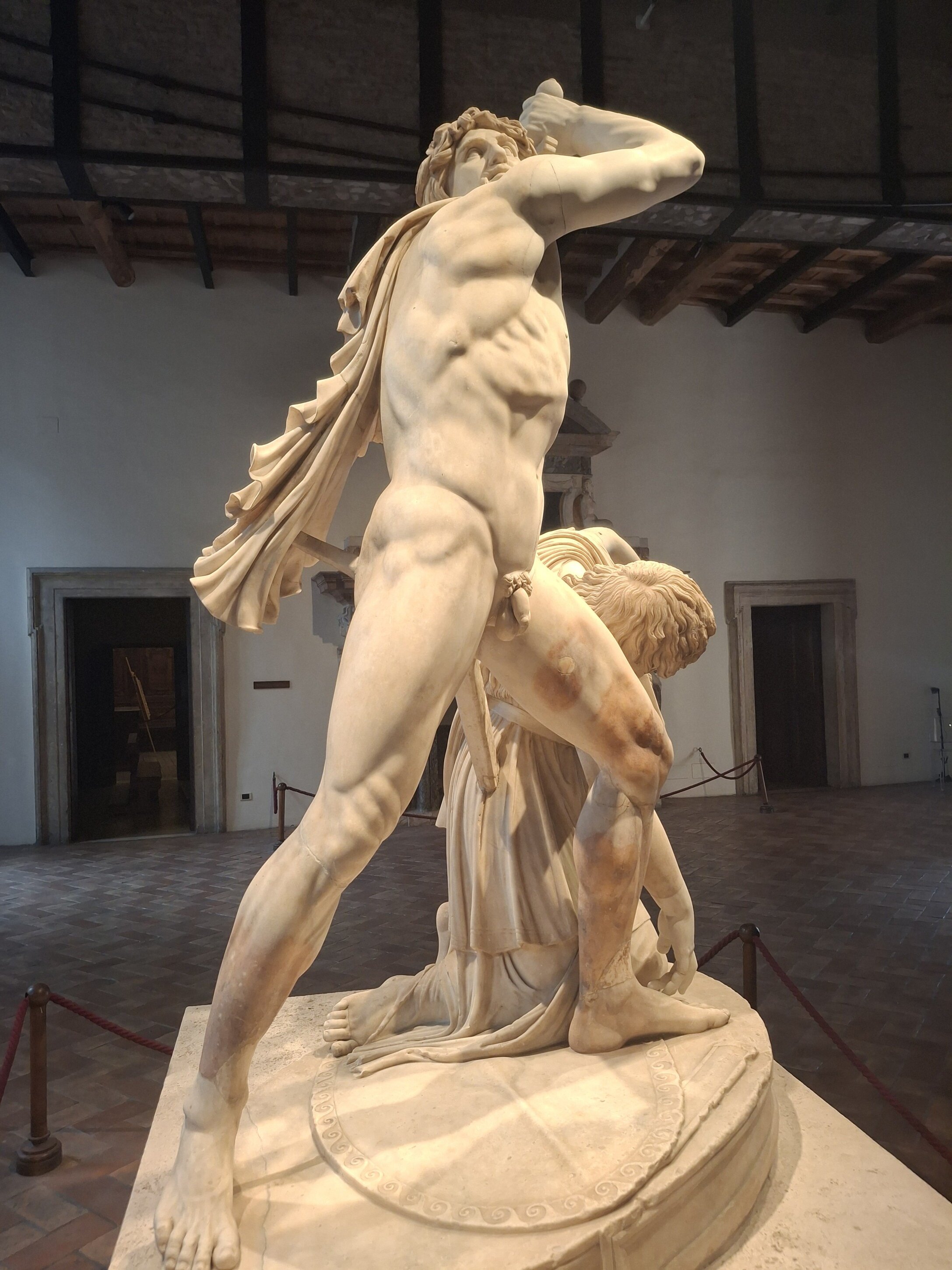
In the main hall of the Museum of Palazzo Altemps in Rome you can admire, besides the "Dying Gaul" that I have already written about before (click here to learn more), also a majestic Roman-era marble sarcophagus, datable to around the 3rd century AD. This artwork, so packed with its reliefs, so rich in historical and artistic cues, is called the Great Ludovisi Sarcophagus, since it too is one of the prized pieces of the collection that belonged to the ancient noble family.
Many controversies are still unresolved, and scholars still debate them. It is clear that the scene shown is a battle, a no-holds-barred clash between Romans and Barbarians, clearly recognizable by certain aesthetic elements (such as the presence of beards and moustaches, typical of barbarian peoples) and by their posture. This last word is key to understanding the artwork and, above all, the very way Romans of the past understood art. All Roman artistic production, both private and public, had a strong propagandistic bent, as we would say today. Rome must always be seen as victorious, the winner and unbeaten. Rome, also by extension and through its army, must always defeat its enemies, it must dethrone them. And the enemies par excellence, the so very famous Barbarians, must always be shown as defeated, close to defeat, ready to die at Roman hands or even by their own. A self-celebration of Rome, visible also through the Barbarians’ attitude, seen for instance on this sarcophagus through poses and stances that suggest defeat and submission. Some are pierced by a spear, some trampled by a horse, some lie on the ground. It is easy to see who wins and who loses, basically. But there is more in this extraordinary sarcophagus! First of all, we still do not know well who, precisely, these Barbarians are: judging by their clothes perhaps they are Goths, but we are not yet sure (and this label is quite broad as well). Also, we do not know whether a battle that truly happened is staged here or whether, more likely, it simply aims to stress Rome’s power, able to crush every enemy. Bodies twist and crowd together, horses and horsemen almost fused and compressed in a tight space, an almost suffocating space. There are no empty areas, everything is filled with marble reliefs.
Reliefs that, among other things, thanks to their depth create a truly outstanding play of light and shadow, enough to give a sense of depth—pardon the pun—remarkable. Moreover, as mentioned before, the reliefs cover the whole surface, in an horror vacui (literally fear of emptiness), so strongly felt by Romans and Greeks. An architectural surface must be completely covered, since nothing must be left prey to the Void, which in Greco-Roman cosmogony equals Chaos. Among all the figures, lastly, one stands out in particular: in the center there is a horseman with his left arm raised, almost as if pointing the charge to his comrades-in-arms. He seems like the general, or the man in the front line urging his men to ride over and destroy the enemy. This figure has, on his forehead, a sort of X, which perhaps could highlight the soldier’s belonging to the cult of Mithras, very famous and widespread at the time. Aside from this, I think it is easy to be left speechless by the beauty of the Great Ludovisi Sarcophagus, which even today amazes for its details and the emotional charge it lets shine through.