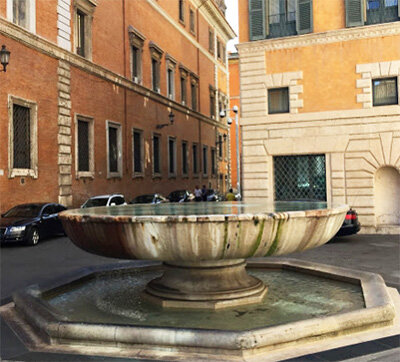
In the photo you can see the Fountain of the Books, one of the historic fountains commissioned during the Mussolini era and built in 1927 from designs by the architect Pietro Lombardi. He was commissioned to design several fountains, small in size but important for their role: in fact, they were meant to symbolize the historic rioni and districts where they stand.
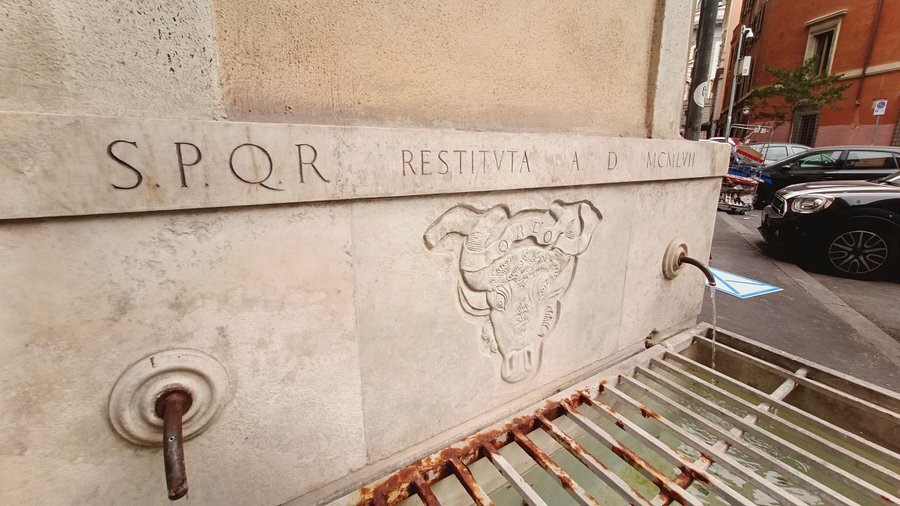
For example, in Rome we find the Fountain of the Pine Cone (rione Pigna, near Piazza Venezia), or the Fountain of the Tiaras (Porta Angelica, rione Borgo). All by Lombardi, all able to bear witness to something that, in part, is no longer there. Take, for instance, the street where the Fountain of the Books is located: Via degli Staderari. The curious name comes from those craftsmen who, in past centuries, opened their workshops and shops here to build steelyards and scales. It is interesting to know, however, that the real, original Via degli Staderari was the one parallel to this. Because of the widening of Palazzo Madama, the original Via degli Staderari was suppressed, and the name was given to this alley. What was it called before this change? Via dell’Università. And here we return to the Fountain of the Books. As you can easily guess, the name comes from these large volumes, resting on two big bases that almost look like tables. Between the volumes there is the muzzle of a deer, with a word above it (S.EUSTACCHIO). Above, along the arch, we find the classic SPQR inscription, one of the symbols of Rome. What do we owe all this to? First of all, the big books, as well as the old name of the street, take us back to when, in the building on which the fountain rests, the University La Sapienza was inaugurated in the early 1300s, the first in Rome and among the oldest in Italy. Where today there is the beautiful Church of Sant’Ivo alla Sapienza (as it happens), the first Roman university once stood. Only later was the University City moved to its current site. The small jets that come out from the edges and from the covers of the books could also symbolize the sweat, in abundance, spent by all those students who in past years toiled and sweated in the classrooms of the old university. And the deer, instead?
The animal is closely linked to the name of the rione itself, which also appears in the inscription above the animal’s antlers: rione Sant’Eustachio. According to his hagiography, this Christian martyr became a fervent believer, from the pagan he had been, precisely during a hunting trip after a deer, above which a great Cross appeared that led Eustachio to conversion. According to the Legenda Aurea, from which this episode in particular is taken, we read how Placido (this was the man’s name before his conversion), heard these words coming from the animal: "Placido, why do you persecute me? I am Jesus whom you honor without knowing". So one understands the link between the deer, the fountain, and the rione. But there is just one last, small, gem: the stonecutter engaged in carving the saint’s name, perhaps distracted or who knows for what other reason, made a serious mistake. Read the inscription: you find EustacChio carved. There is an extra C!!! Sometimes mistakes are found even in the strangest places...