

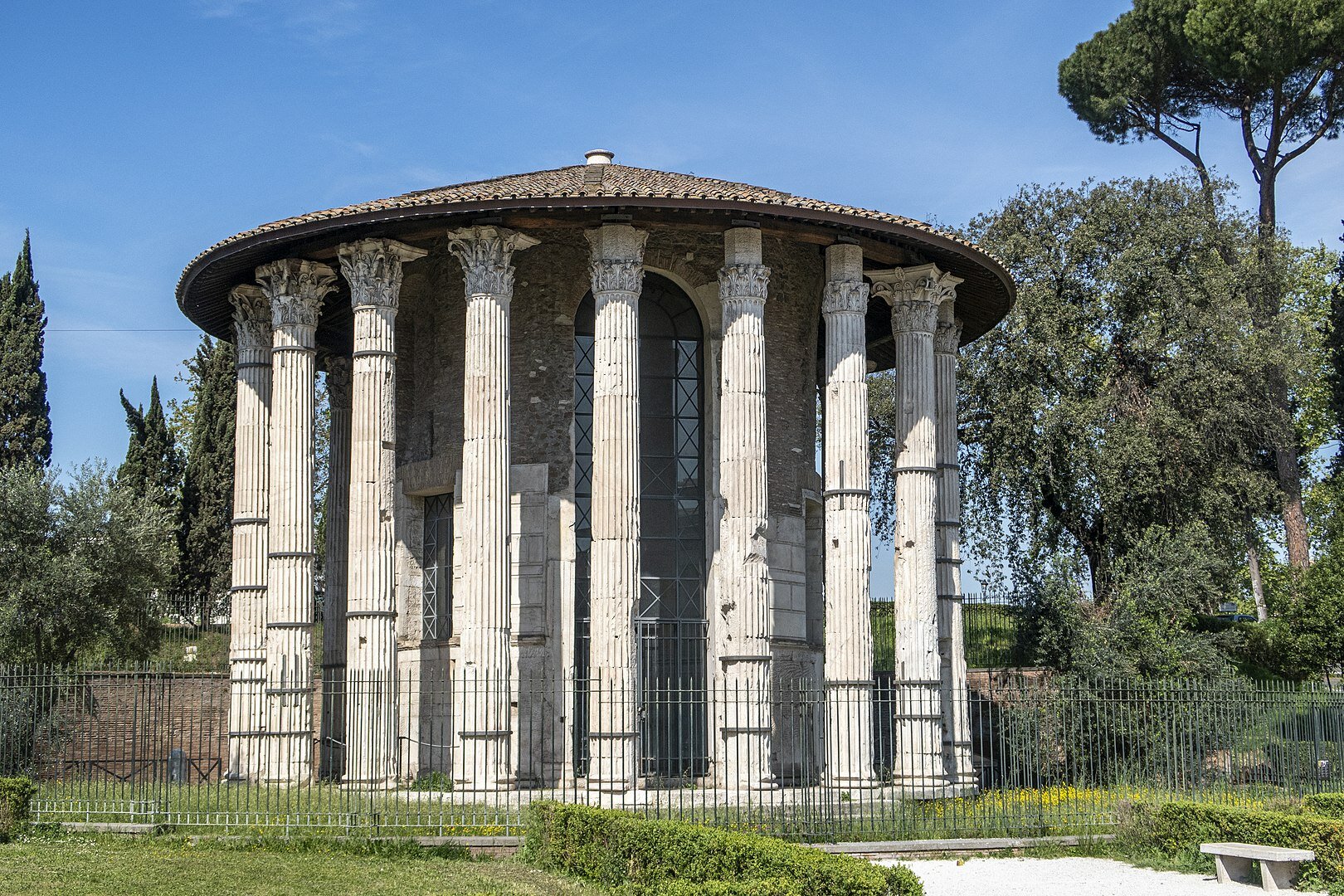
Near the wonderful church of Santa Maria in Cosmedin, which I wrote about last week, and close to the marvelous, so-called Arch of Janus, stands a building unmistakable for its shape. An ancient temple complex that has somehow become a symbol of Rome itself. Right here, on the banks of the Tiber, your local tour guide today tells you about a very interesting temple, which has survived the centuries and history: the temple of Hercules Victor.
The temple of Hercules Victor has its unmistakable charm, especially due to its circular shape which has made it absolutely recognizable. Precisely because of this peculiarity, however, for centuries it was mistakenly thought that the temple was dedicated to Vesta, taking as a model the original temple of Vesta located in the Roman Forum. But there is much more! The temple of Hercules Victor is the oldest marble building still existing and dates back to 120 BC. We are in the area of what was the Forum Boarium, where the market for animals and meat was held, and which already in archaic times was the emporium area where Phoenician and Greek markets had settled, bringing with them the cult of Hercules. It would not be at all strange, after all, to find a sacred altar or in any case a sacred building dedicated to Hercules here, right in this area. The semi-divine figure, for the Romans, represented many things, not just brute strength. Hercules was also the protector of sailors and commerce, in some cult forms, and so it would not be strange to find a temple of his here, in the most important market of archaic and ancient Rome, where for the first time the Urbs opened up to the outside world through trade (fundamental was, for example, the construction of the ancient Pons Sublicius). The confirmation of the current dating, the 2nd century BC, is due to an inscription on a block of marble, which could have been the base of a statue, in which it was confirmed that the temple was dedicated to Hercules Olivarius. We also find the name, which is rare, of the sculptor of what must have been the statue: Skopas Minor, who lived in the 2nd century BC. The construction of the temple is owed to a wealthy merchant Marcus Octavius Herennius, who became even wealthier thanks to the oil trade (hence the name Hercules Olivarius). In particular, however, we learn the real reason for the erection of the temple thanks to Macrobius, who tells us how the merchant, during one of his commercial journeys, was attacked by pirates whom he managed to defeat after asking for the protection of Hercules. The Temple was located in an area subject to periodic flooding by the Tiber, and already in ancient times suffered damage for which it had to be restored; the last restoration of which we have news dates back to Tiberius, probably after the flood of 15 AD. Like all buildings that have come down to us intact, the temple of Hercules was also transformed into a church; in 1132 it was consecrated to Saint Stephen of the Carriages and later in the 17th century to Santa Maria del Sole for an image of the Madonna found not far away. The original temple, net of the various destructions, modifications and renovations, was indeed circular in shape, accessible via six or seven steps. The heart of the temple is the circular cella, the so-called Aedes Rotunda. Today it is surrounded by 20 fluted columns, probably originally in Pentelic marble, today in white marble from Luni (we see, in fact, what remains of the deep restoration carried out under Tiberius). The cella even had a domed roof. All these stylistic and architectural elements reveal how the place of worship was much closer to Greek craftsmanship and tradition than to Roman ones. As I wrote at the beginning, however, the last word has not been said. From ancient sources we know, for example, that other temples were erected here in the area, always dedicated to Hercules: Appius Claudius the censor is said to have built one in 312 BC dedicated to Hercules Victor and which should be behind Santa Maria in Cosmedin in an area not yet excavated, while in 142 BC Scipio Aemilianus also built one. But ancient sources also tell us that a temple to Hercules Invictus stood near the Trigemina gate, much closer to the Aventine than here. The historical tradition, the shape, the archaeological evidence all actually point in the direction of Vesta, of a circular temple dedicated precisely to her. Moreover, there are many temples dedicated to Hercules, over the centuries, always here in the same area. The sources, therefore, are numerous but, at the same time, bring a bit of confusion to today's archaeologist.
Only the epigraph found, as mentioned before, tells us clearly that this temple would be dedicated to Hercules. So, as you can see, there is something that does not add up or fit. After all, however, this is precisely the beauty of archaeology: today we study the historical, archaeological and literary fragments of what the Roman civilization was two thousand years ago and more. They are only fragments, pieces of reality that are sometimes difficult to understand and put back together, in order to then form the complete mosaic of the situation. But perhaps, after all, this is precisely the beauty of it!





















