

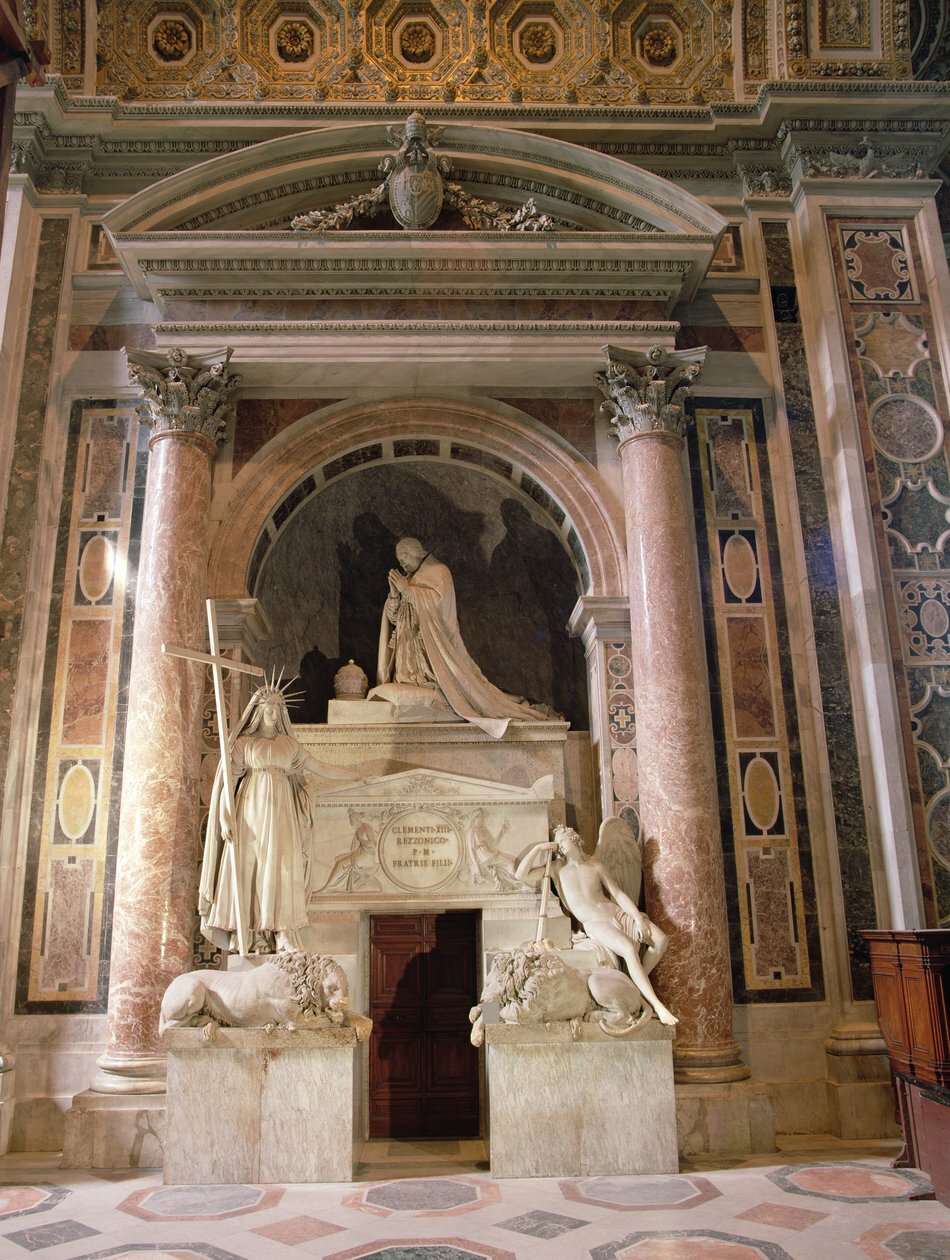
The Basilica of Saint Peter is full of funerary monuments, if not actual tombs, of modern and past pontiffs. Some of them are true masterpieces (how can one not think, for example, of Bernini's designs and that wonderful one dedicated to pope Alexander VII, as you can read here), and among these today I would like to talk about one in particular: the funerary monument of pope Clement XIII, designed and conceived by Canova, located in the right transept of the Basilica of Saint Peter.
The Venetian Carlo Rezzonico was elected pope with the name Clement XIII from 1758 to 1769. Of a very amiable and charitable personality, he interpreted his apostolate on these bases, presenting himself as a good shepherd and not as a statesman interested in international political and diplomatic affairs. In short, according to the chronicles, this pontiff was a happy figure in the long history of the papacies of the Church, the figure of a man completely devoted to his pastoral mission, not at all inclined to be a sort of Pope-King. And Canova, once he received the commission, fully followed this character and political approach. Starting from the top of the pyramid on which the funerary monument is based, there appears the humble figure of the Pope, kneeling and engaged in deep prayer. The tiara, a symbol of the power, even temporal, of the pontiff, is symbolically placed on the ground, in another extreme act of humility. Going further down, in the center, there is the sarcophagus with clearly classical forms (let's not forget that Canova was the master of so-called Neoclassicism), while, going even lower to the level of the observers' eyes, some allegorical figures stand out: the woman with the Cross, the personification of Religion, and the winged creature who is the Genius of Death (taking up and reworking some funerary traditions of the Roman era). The two lions are also impressive, symbols of strength but also, for millennia, practically the preferred guardians of tombs. Animals that, according to very ancient and not very truthful stories, could sleep with their eyes always open, ready to keep watch. And here, to complete the small analysis of the work, let me mention a legend that concerns one of the lions, the one on the left if you are facing the tomb. Canova, like many sculptors and architects of the time, actually often did not work alone. Other artists and craftsmen worked with him, known by Canova and worthy of the master's trust, each with a very specific task: from stonecutters to those who had to polish the marble, to assistants who had to find the right material. Today we would say that Canova, just as another great before him, namely Bernini, did, worked extensively in a team. Indeed, sometimes it could even happen that Canova only developed the project, then limited himself to overseeing the work. Well, now it is said that among Canova's collaborators there was one with a truly peculiar surname: Elefante (Elephant). This Mr. Elefante, working day after day in the shadow of a great master like Canova, who knows how many and what aspirations he might have had: was it enough for him to work under Canova? Did he want more, to go out on his own? Did he have enough self-esteem to try to reach the value of a recognized master like Canova? We do not know, but apparently, Mr. Elefante began, day after day, to beg Canova. The request? To leave a tangible mark of his art, a sign that could remind everyone, and especially posterity, that Elefante too had collaborated and helped create the work. After much insistence, it seems that Canova, perhaps out of weariness or true pity, decided to grant his subordinate's wish. Well, now go to the left, standing right behind the lion. If you see the tail and the shape of the lion's back, it really looks like a trunk! Incredible, isn't it?
How many traditions, sometimes invented, sometimes less so, can there be in Rome? This is one of them, but surely the Eternal City also impresses with the oddities that some masterpieces, even inside historic buildings like the Basilica of Saint Peter, can express. And let us not forget, then, that we are talking about a work of art created by a master of art in every way who, for example, sculpted the famous Paolina Bonaparte at the Borghese Gallery. In the end, after reading what I have written, you might have a little extra motivation to visit one of the symbols of Christianity and of all Rome.





















