

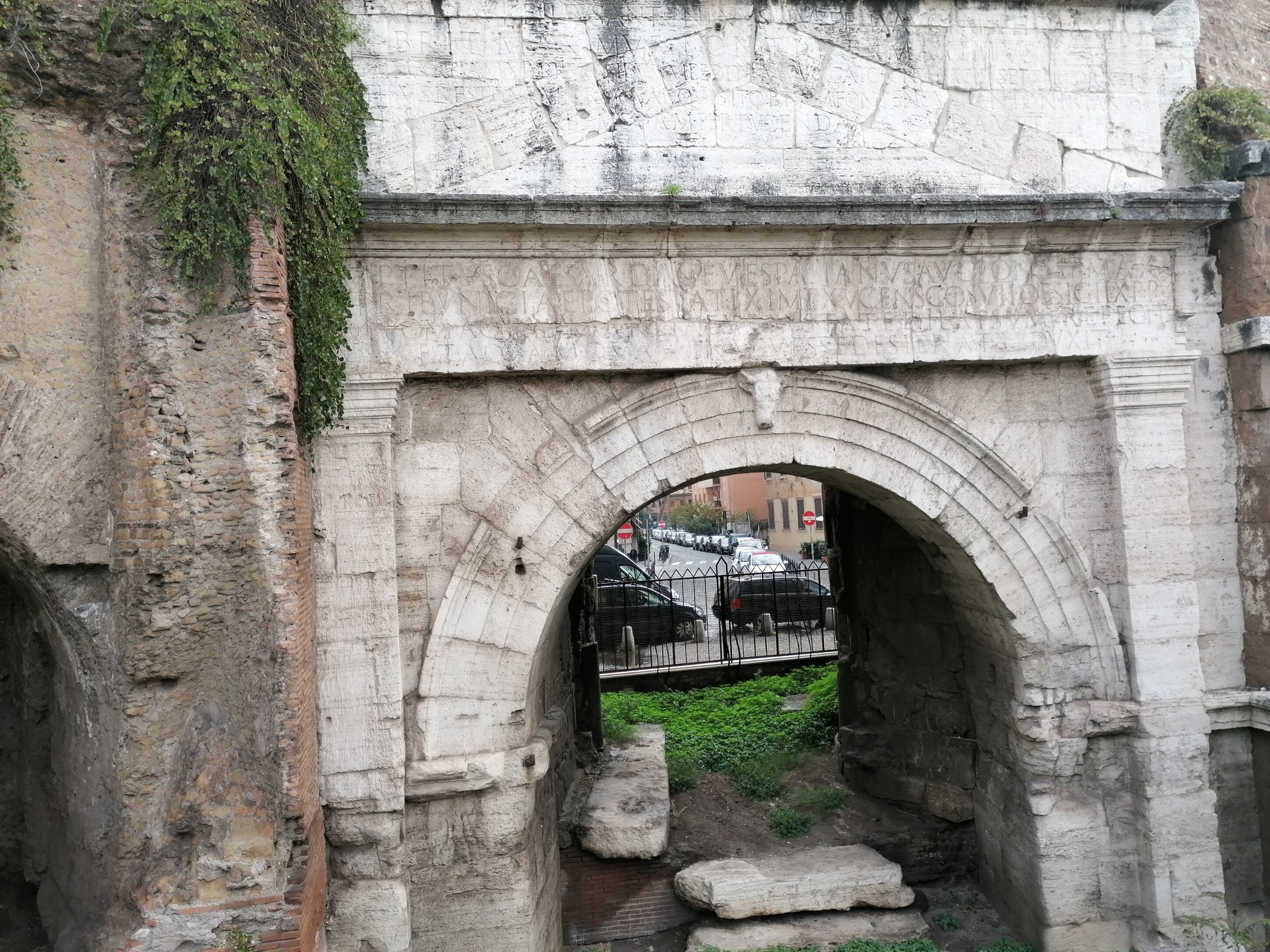
It is roughly from Porta Tiburtina, also known as Porta San Lorenzo, that one of the most famous consular roads in all of Rome begins: the Via Tiburtina. This is yet another example of how the Eternal City is special, even in those defensive walls that, for centuries, tried (often with success) to stop the advance of any invader or enemy. As a local tour guide I have already had the opportunity to mention the sackings that the Urbe was condemned to suffer (as in this case), but it is still interesting to understand how an entrance that opened in the city walls could be much more than just a defensive bulwark. So, let's see why Porta Tiburtina plays an important role in the history of the city.
Let's think, first of all, about the famous Via Tiburtina, which originated here. This road, whose root comes from Tibur, that is, the ancient city known today as Tivoli, was certainly one of the most traveled in antiquity, especially in the republican age. After all, Tivoli is part of the same history as Rome, so much so that it even has a very similar origin. Let us never forget how, at the gates of today's Tivoli, the quarries from which the Romans extracted much material, especially travertine, still stand today, later used to build some of the most impressive monuments in all of the Urbe, such as the Colosseum. It is no coincidence that, at the origin of Porta Tiburtina, there is a monumental arch commissioned by Augustus and erected in 5 BC. Much later, only in the second half of the 3rd century AD, Porta Tiburtina was incorporated into the circuit of the Aurelian Walls, commissioned by Emperor Aurelian. But the evolution of the gate is greater, as it was completely restored under Emperor Honorius at the beginning of the 5th century AD, and then remodeled several times over the centuries, especially in the Middle Ages. And this long historical evolution can still be seen today! Below the current arch, flanked by two square towers, there is still the monumental arch commissioned by Augustus, with all its peculiar characteristics. The travertine arch, in fact, still features reliefs of bucrania, that is, bull heads used as decorations (also visible, for example, on the Ara Pacis or the monument to Cecilia Metella on the Via Appia Antica). Hence one of the nicknames given to the arch, Porta Taurina. Not to mention the original inscriptions, still present, which indicate how the monument commissioned by Augustus was used to connect three Roman aqueducts before officially bringing them into the Urbe: in this case we are talking about the Aqua Marcia, the Aqua Iulia, and the Aqua Tepula. A similar destiny and function was also had by Porta Maggiore, located not far from here. And just as in the case of the latter, Porta Tiburtina was also opened, especially with Aurelian when he transformed it into a defensive bulwark, a short distance from or at the junction of two roads. In this case, in fact, Porta Tiburtina is located between the Via Tiburtina and the ancient Via Collatina. And also Porta Maggiore, after all, is at the junction between Via Casilina and Via Labicana. Speaking of the outer gate, moreover, the one you see in the photo and which dates back to the 5th century AD, there are some historical elements that allow it to be dated with precision. We know from ancient sources that the five small windows you see, and the reinforcement that the whole structure received, date precisely to the reign of Honorius in the early years of the 5th century AD. In an inscription, then, one name stands out: Stilicho. He was the commander-in-chief of Honorius's army, Emperor of the Western Roman Empire. However, due to political problems, also following events involving Alaric and his Visigoths, Stilicho was killed. He too, like others before him (including Nero), suffered a damnatio memoriae, that is, the erasure of his name from all public inscriptions. Only, evidently, something was forgotten, so much so that Stilicho's name can still be read today on the inscription of the gate.
Here, then, is why even Porta Tiburtina, today partly submerged and suffocated by the modern city, is able to tell very interesting and intriguing stories. The fact, moreover, that the original walking level is not at the same level as the current one (and this gate shows it clearly), indicates even more how the Urbe is a remarkably historic city, and remarkably fascinating. So many things, in short, can be said about a simple spot in Rome that, however, has a history stretching back two thousand years.



















