

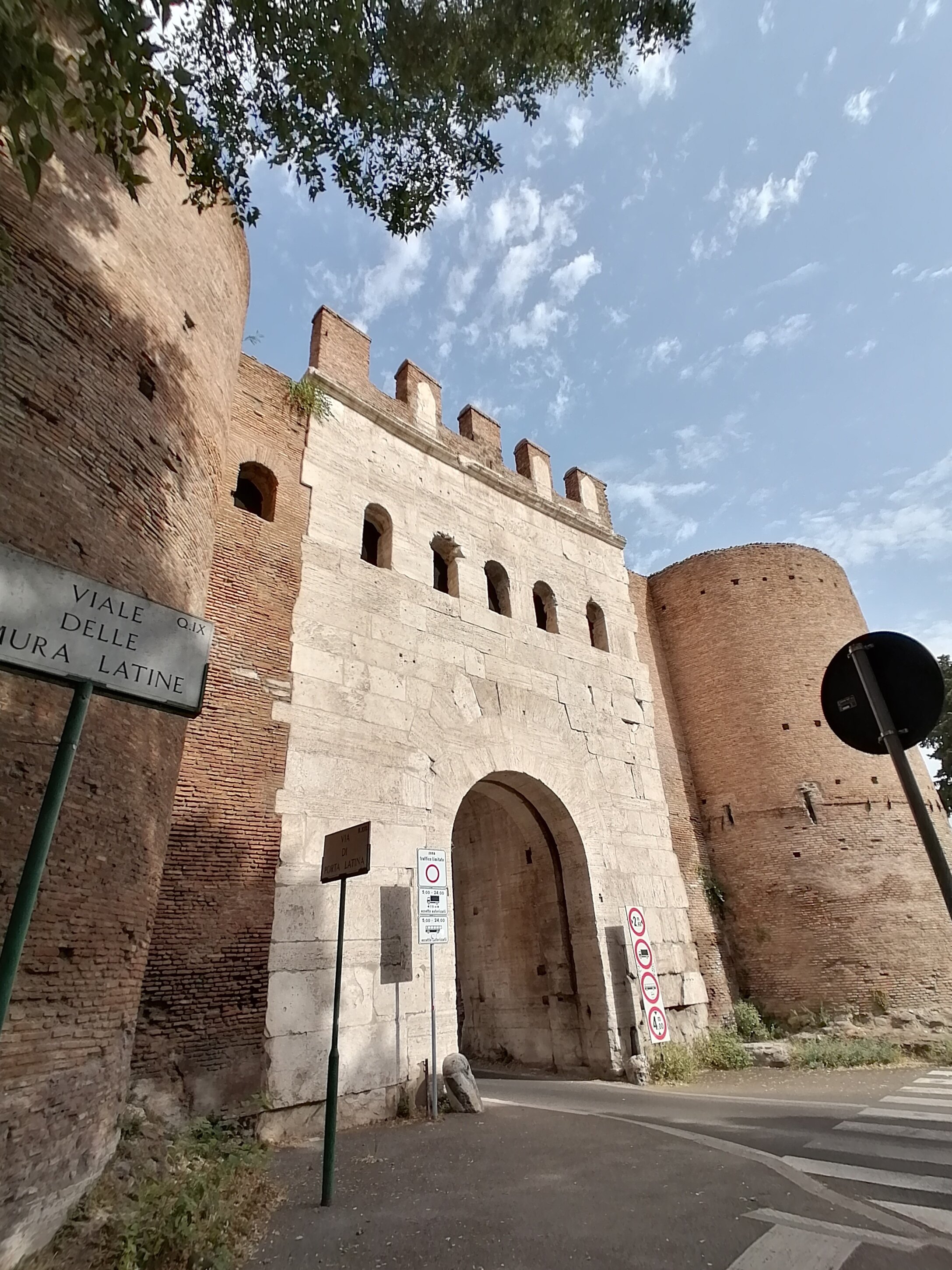
Today, your local tour guide in Rome would like to talk to you about one of the monumental entrances of Rome, one of those entrances that the Romans opened along the approximately 19 km of the Aurelian Walls. The city walls, which I remind you were built in the second half of the 3rd century AD by order of Emperor Aurelian, also with the help of the legionaries, are largely still standing, as are many of the gates of the era. Famous is Porta del Popolo, as you can read here, Porta San Sebastiano (where the Museum of the Walls is located) or Porta Tiburtina. And right next to the latter stands the so-called Porta Latina, perhaps less known than the others but, rest assured, equally surprising. After all, it is from here that you must access to admire the wonderful medieval church of San Giovanni at Porta Latina (here to learn more). So, let's discover a little more about this monumental entrance.
First of all, let's start by saying that the genesis of this entrance is much older than one might think, as the first Porta Latina would have been opened on the Servian Walls, the first true city walls that Rome used, initially erected in the 6th century BC and then reinforced two centuries later. According to legend, the name of the gate would derive from the god Saturn who supposedly hid here in the area to escape the wrath of his son Jupiter, who wanted to kill him. The term hidden, in Latin, is latens... But leaving aside the legends, it is true that the name Porta Latina derives from the homonymous road, one of the most ancient traced by the Romans, which connected the Eternal City with Capua, towards the south. Probably the aspect we see today has not changed much over the centuries. Chronicles tell us that it was Emperor Honorius, at the beginning of the 5th century, who carried out some restoration work, even lowering the arch a little for defensive reasons. It is also very likely that the original structure of the entrance always had a single arch, as the Via Latina was probably, although important, of secondary relevance compared to others.
Before concluding, however, a little curiosity that makes one reflect on the sometimes pitiless state of the city walls and in general the historical heritage of ancient Rome. It seems it was a practice, attested by numerous documents, to grant concessions to private individuals, often for a year, for the management of the city entrances through the walls. Private individuals, then as now, could demand a toll, as the entrance was given to them for management! A practice that lasted at least a thousand years, from the 5th century to the 15th century. In a document preserved in the Vatican Archives, for example, we learn that in 1474 the Porta di Via Latina was given in semi-annual management for "39 florins, 31 shillings, 4 pence". A not very high amount, but still respectable. A few numbers that on one hand attest, again, to the not excessive traffic of people and goods through the entrance, and on the other hand how, sometimes, there is always a way to profit from what the ancient Romans left us.



















