

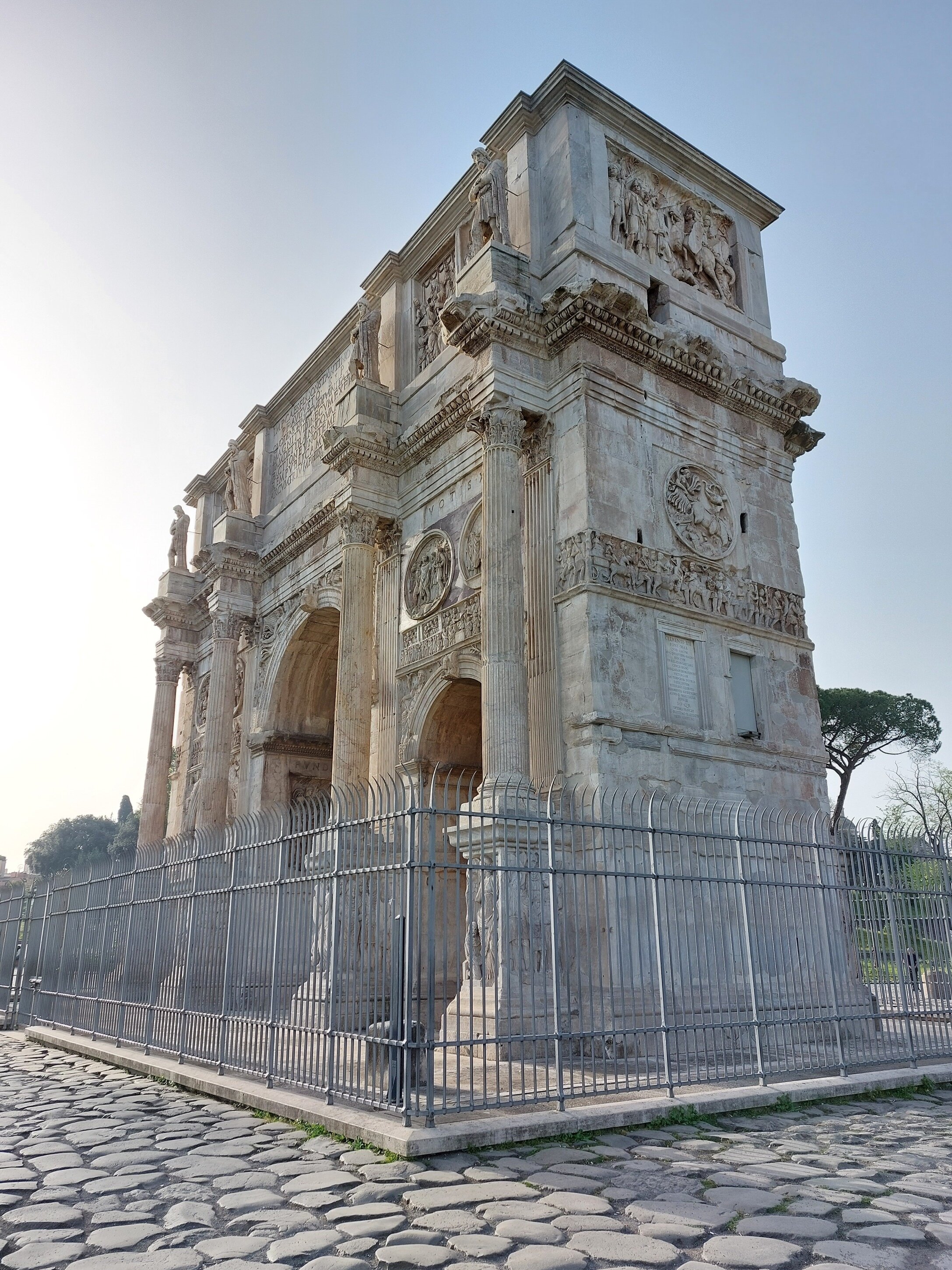
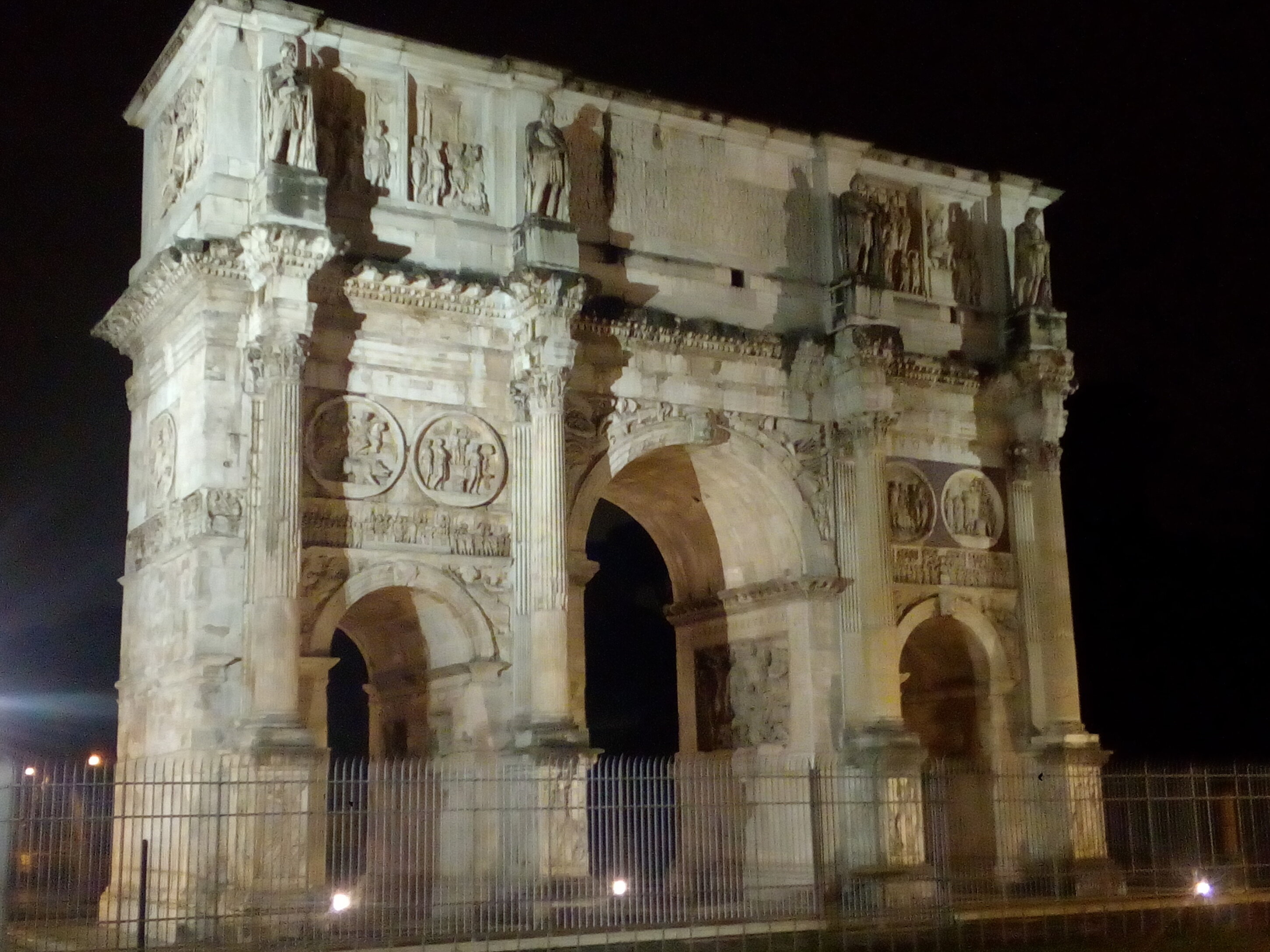
The Arch of Constantine is many things all together: a monument, a political manifesto, a great historical puzzle. Without a shadow of a doubt it is one of the symbolic monuments of ancient Rome, an artifact which, to describe it, would take pages and pages. During a classic tour of the Colosseum it is easy to stop for a moment in front of this incredible work which represents, to all intents and purposes, an emperor who has truly changed history. But let's see together something more about this magnificent triumphal arch, certainly not the only one in Rome (try to click here).
Commissioned by the Senate and inaugurated in 315 AD, this triumphal arch was donated by the senators to Constantine the Great, who only two years earlier, confirming a pre-existing edict, gave freedom of worship to Christians. The text of the edict which profoundly changed Roman society and religion is as follows: "We, therefore Constantine Augustus and Licinius Augustus, having met profitably in Milan and having discussed all the topics relating to public utility and safety, among the provisions which we saw useful to many people or to be implemented among the first, we have placed these relating to the worship of the deity so that Christians and all others are allowed the freedom to follow the religion that everyone believes, so that the deity who is in heaven, whatever may it be, to us and to all our subjects give peace and prosperity". For this reason, its triumphal arch still stands near the Colosseum, right along the ancient Via dei Trionfi. Indeed, for the Christian communities of the time, Constantine was a real hero. A hero, however, whose contours are not very precise. Even today it is thought that the emperor was not a true Christian and had never converted (as instead would have happened in a church right here in Rome, as you can read here). His actions in support of Christianity were dictated by purely political motivations, which aimed to find support in those increasingly numerous Christian groups in Rome. Perhaps this is why we find written instictu divinitatis (by divine inspiration) in the inscription on the arch. Something very vague, which does not touch the Christian God or the pagan Gods. It should also be considered how Constantine was a fervent faithful of Sol Invictus , an oriental solar divinity similar to a God and, above all, to a central and absolutist power like the one he wanted to establish. After all, Christ was also depicted by the very first Christian communities as a man crowned with the Sun (an iconography certainly not new and also used in other areas). Furthermore, there was a lot of confusion at the time about who should be defined as a Christian and who was not, so much so that Tertullian himself (Christian historian) wrote the following: "many believe that the Christian God is the Sun because it is a known fact that we pray facing the rising Sun and that on the Day of the Sun we give ourselves to joy".
Despite this, the reliefs and decorations of the arch are all Roman in style, with sacrifices to the divinities, hunting scenes and so on. Too bad there is practically nothing original! The Arch of Constantine is, in fact, a large marble collage. Probably built on the basis of a previous triumphal arch, perhaps belonging to Hadrian, some of the reliefs of the monument dedicated to Constantine were detached from other previous buildings. The statues positioned on the plinths, near the inscription, are from the Trajanic age (two centuries earlier), while the reliefs on the roundels are from the Hadrian age (again two centuries earlier). In short, between winged victories, battles and subjugated barbarians, the arch of Constantine is certainly unique in the Roman panorama. If you look carefully at the reliefs, you will see less realism and naturalism, especially in the portraits of the characters represented. We are moving more and more towards a symbolism and a communication that will then be common in the Middle Ages. A triumphal arch, therefore, which is a real bridge between antiquity and modernity, between emperor and God, between the Roman and Christian worlds.





















