Probably the most impressive monument at the Archeological Park of Ostia Antica (close to Rome) is the so called Capitolium, a great architecture which symbolized, in some degree, the deep connection between the colonies of Rome and the main city. The Capitolium is one of the emotional springs that could push you to come and visit Ostia Antica, an archaeological park envied all over the world. Being a tour guide, mainly a local one, I have to tell you: visit it!
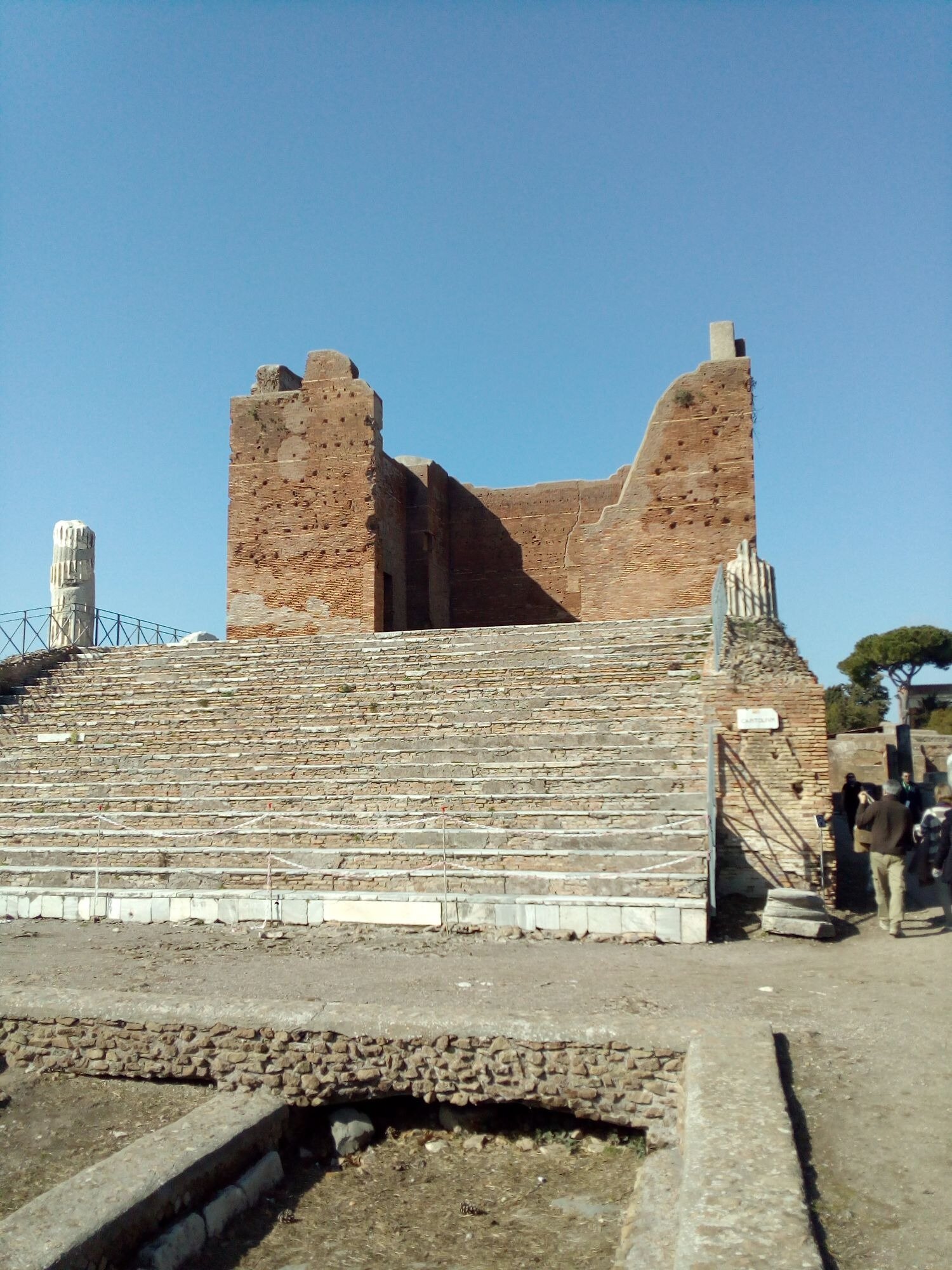
We are located in the area of the Forum of Ostia, the central square of the town community hosting the largest port of the Eternal City. It was important for the ancient Rome because was that point where most of the goods that helped the city to prosper converged. As usual, the Forum was the political and social nerve center of each single ancient roman city, and for this reason it was deeply embellished with monuments of all kinds. And the Roman colonies, especially the richest ones or those particularly linked to the city, wanted in every way to remember the connection with the mother country. For this reason a building like the Capitolium was present in other Roman realities. In other urban contexts that in this way remembered, also architecturally and physically, the very reason for their existence. What does a Capitolium consist of? As we see in the photo, the building is an elevated temple, resting on a high podium, whose entrance can be reached via 21 marble steps. It almost seems to climb a... hill! In fact, the Capitolium was intended to be a reproduction of the Temple of the Capitoline Triad in Rome, which stood on the top of the Capitoline Hill (Capitolium in Latin). Today, unfortunately, little remains of the magnificence and opulence marble decorations that adorned this building, built at the behest of Hadrian at the beginning of the 2nd century a.D., remain.
The Capitolium was stripped of its marble slabs that decorated the floor, and also of the roof, perhaps collapsed due to natural causes, which made the building almost 20 meters high. It had to be a magnificent architectural complex, solid in the walls and in the form but also embellished with various friezes and decorations which, unfortunately and as often happens also in Rome, were recycled, reused or simply destroyed by atmospheric agents or human activities . It must be said that the area of the Forum is located, as was the custom at the time, practically at the junction between the two main routes that crossed Ostia: the Cardo and the Decumano (with north-south and east-west orientations). Especially coming from the north, those who went to the city would have walked a large avenue flanked by arcades with, in the background, the red bricks of the back of the Capitolium. The building had to be seen even from a great distance and should have represented an exceptional scenic backdrop in the eyes of travelers, merchants or sailors who landed in the port of Ostia and who, perhaps for the first time, came into contact with Latin civilization. Surely the Romans knew how to amaze, and the Archaeological Park of Ostia Antica of Rome still does the same today, with its inimitable atmosphere.