

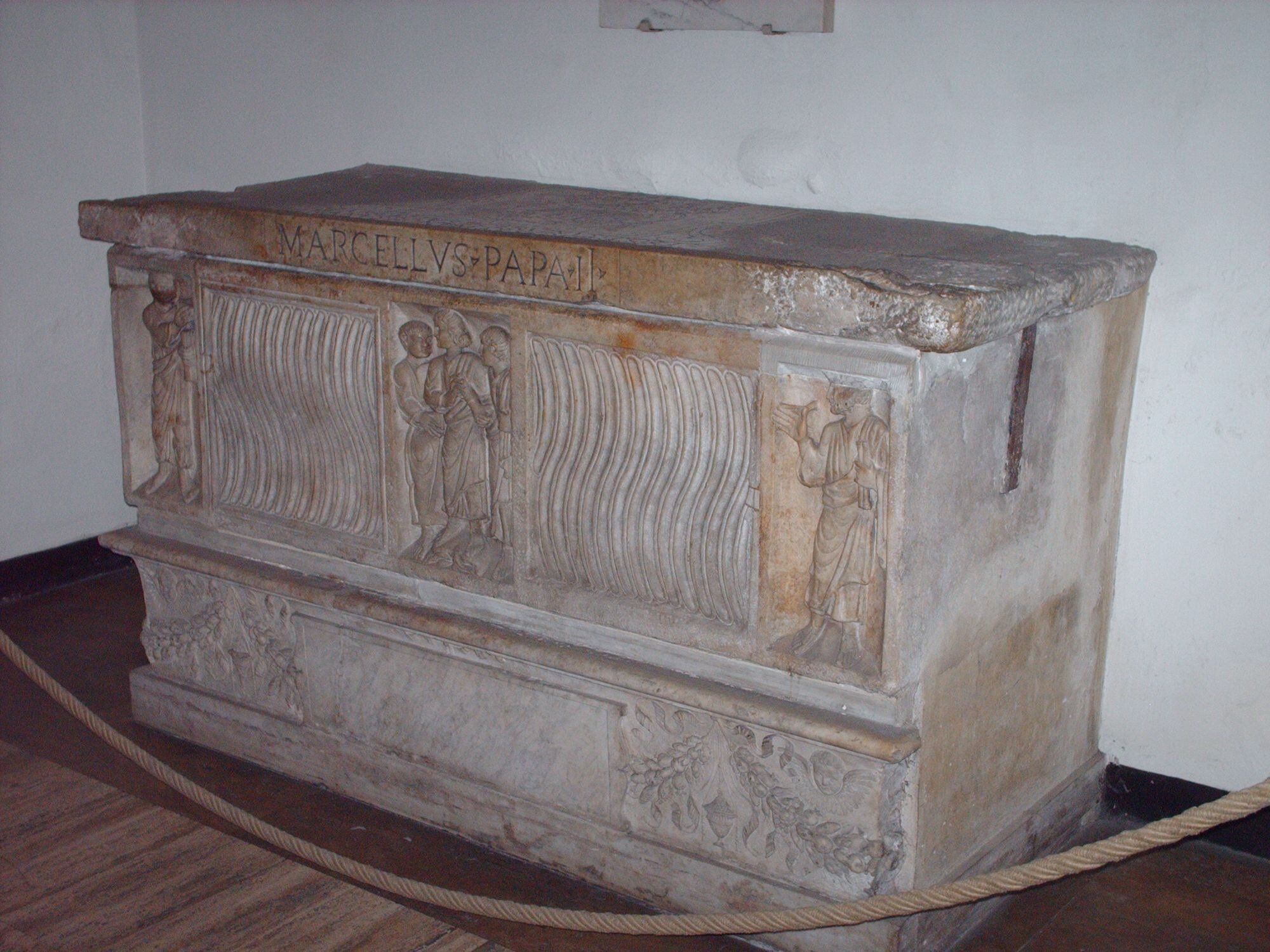
The Vatican Grottoes at the St Peter's Basilica of Rome are an almost magical, mystical place, due to the numerous tombs, belonging to popes of all ages, which were placed here since many centuries ago. Very close to the place where, according to the traditions, St Peter is buried (and here you can read something more about it), these underground tunnels, excavated and enlarged from the 1500s until a few years ago, conceal some very particular curiosities, such as the one inherent to the tomb you see in the photo.
It is interesting to note how an ancient Roman sarcophagus was reused to house the remains of a pope, but this is after all only one of the many examples of reuse in Rome. In my opinion it is even more interesting to note that the tomb is dedicated to the pontiff Marcellus II, who became pontiff in the mid-16th century, a man who tangibly represents the fulfillment of a sort of... curse! We could spend hours narrating the events that saw the popes buried here as protagonists, but this man named Marcello has a peculiarity: he was Pope only for 22 days! Apart from the brevity of his pontificate, this man stands out for his policy which today, without any difficulty, we will call of austerity. In a few days he radically changed the way of behaving and being of the papal court, which at the time resembled a real court, with men (and women) dedicated to activities that were anything but spiritual. For example, Marcellus II commanded that the cutlery he should have used as pontiff, which history tells to be made of fine silver and gold, should be melted to give the proceeds from the sale of this material to the poor people. Moreover it seems that he did not allow his grandchildren to stay at the Vatican apartments, as many of his predecessors did. In this way, he thwarted any nepotistic attempt, also because the pope himself did not consider such practices in keeping with the role he held. He also reduced the expenses for the celebrations organized on the occasion of his investiture as pope, giving orders to use any economic surplus for the poor and needy. Could it be for this reason, say the evil ones, that the pope died after only 22 days? Was it because of his anti-caste policies that, perhaps, he was wiped out?
We do not know, but there is also another curiosity: since the Middle Ages, all the Popes chose their name by changing their birth names. Since John XII, who made his name Octavian, all the men elected as pontiffs changed their baptismal name. It seems that a curse was looming, and that anyone who would have kept their first name, even if invested with papal power, would have died within a year. Well, after John XII, we are in the middle of the Middle Ages, the only Pope who went against this tradition was Marcello, who kept his birth name. And we know how it ended up...





















